By Aldus Penwright, Senior War Correspondent, The Times-Observer
The calm that once lay over the northern frontier was broken on Fourthday morning by the sharp, unmistakable crack of rifle fire. What began as a routine patrol near the River Nord crossing has now become the first recorded exchange of hostilities between Eyehasseen and Marelia in over three decades.
The Incident
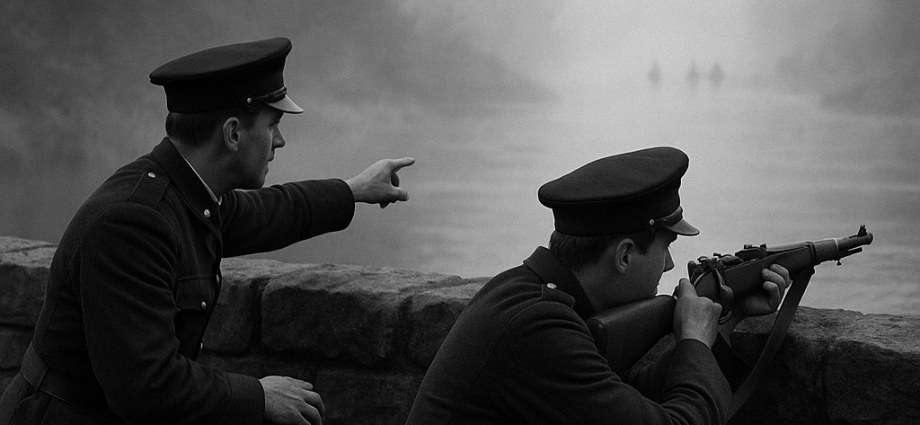
According to an official report issued by the Ministry of War & Conflict, a detachment of Royal Border Constabulary stationed at Outpost Nine encountered a Marelian patrol advancing within sight of the neutral strip separating the two nations. Each side, it appears, believed the other had crossed first.
At 5:37 a.m., amid heavy mist, three shots rang out. The first two, according to a surviving sentry, “hit the stonework of the parapet clean and close.” The third was fired in return. When the smoke cleared, one constable lay wounded in the shoulder. The Marelian patrol withdrew, carrying what appeared to be a casualty of its own.
The Ministry describes the incident as “a grave but isolated breach.” Marelia’s foreign office, by contrast, has accused Eyehasseen forces of “deliberate aggression under cover of fog.”
Eyewitness at the River
The Times-Observer has spoken to Corporal Wren Alcott, a veteran of the Northreach Garrison and one of the men on duty that morning. His account, delivered in the infirmary where he is recovering from shock and minor burns, conveys both the confusion and suddenness of the event.
“You could barely see your own boots for the fog,” he said. “We heard voices — Marelian tongue, sharp and low. Then a flash like lightning, and the stones beside me spat dust. We never even saw their faces. Only their silhouettes and the flash of their rifles. It was over in less than a minute, but it felt like the end of the world.”
Alcott insists his men did not fire first. “We’ve stood that post two winters running. They’ve shouted insults before, sure — but never lead.”
The Official Response
By midday, the Hall of Ministers was abuzz. The Prime Minister convened an emergency session, emerging hours later to issue a measured statement:
“While no nation seeks war, no nation will suffer its borders to be treated as suggestion. The Kingdom remains vigilant and unprovoked.”
The King’s own council followed suit, ordering the Royal Cavalry of Northreach to advance to their standby stations along the frontier roads.
“This is not mobilization,” said Colonel Varrin of the Palace Guard. “It is prudence in uniform.”
Nevertheless, trainloads of troops have been seen moving north under the cover of night, their destination undisclosed but easily guessed.
The Marelian Denial
Across the border, Marelian state newspapers have already published an official denial, claiming that “the Eyehasseen patrol entered Marelian soil in hostile formation.” The article accuses Eyehasseen of “fabricating incidents to justify military expansion.”
The Marelian ambassador in Inverness was summoned to the Ministry of Foreign Affairs before dawn and released an hour later, pale and tight-lipped. “Our governments remain in dialogue,” was his only statement.
The Public Mood
In the markets of Inverness and the taverns of Westmere, talk of war has rekindled the smoldering embers of patriotism. Merchants stockpile salt and flour; smiths polish long-neglected tools of war. “You can feel it in the air,” said one carter near the rail yard. “It’s not wind from the north — it’s the sound of boots coming.”
At the Cathedral, prayers for peace were said at noon. “We must not thirst for blood merely because we smell it,” the Archbishop cautioned. Yet his words did little to calm the restless optimism of a people who, for all their fatigue of politics, never doubt their own cause.
The Forgotten River
The River Nord itself, scene of the incident, is a quiet ribbon of gray water winding through reeds and alder. Once, it was a route of trade and friendship. Now it marks a frontier between suspicion and silence.
Locals recall that in springtime, children from both sides would gather to skip stones together. Such memories feel impossibly distant today. “The river never wanted a border,” said an old ferryman from nearby Hallowford. “Men drew it there with ink. Now they’re redrawing it with bullets.”
What Comes Next
The Ministry has dispatched a special investigative commission to the scene, including officers from the Royal Army, Constabulary, and Ministry of Information. The border post is now sealed. Journalists have been instructed to remain behind the second line of defense.
Unofficially, several observers within the Palace hint that this “fog incident” may serve as a catalyst for long-simmering tensions. The memory of the Midnight Telegram scandal still rankles, as does Marelia’s refusal to surrender agents implicated in the River Docks plot.
As one senior official said on condition of anonymity:
“If Marelia wants to test our patience, they will find it as short as our powder fuses.”
For now, the guns along the Nord are silent. But the silence has changed — it no longer feels like peace, but preparation.