By Reginald Thistlewhite, Historical Correspondent
Few tales in the annals of the Kingdom strike the imagination so forcefully as that of Marrowfield, a farming settlement that vanished in the autumn of 921. Fifty-three souls lived there, tending barley fields and dairy cows, yet one October morning a passing tinker found the village empty. Doors hung open, fires had burned to ash, meals sat uneaten upon tables, and livestock wandered the lanes untended. No trace of the inhabitants was ever discovered.
Marrowfield was not large, but it was prosperous. Situated along the trade road between Sternthistle and North Bibble, it provided food and lodging to travelers. Records in the county rolls show steady harvests and even modest tithes paid to the Crown. Nothing suggested instability.
The first report comes from the tinker, one Alwin Shore. In his deposition to the sheriff of Sternthistle, he swore that he entered the village at dawn, seeking bread, but found only silence. “I called out, but none answered,” he wrote. “A pot still boiled upon the fire in one house, though no hand stirred it. A child’s doll lay in the dust of the lane. It was as if they had all stood and walked away at once.”
The sheriff dispatched a search party. They combed the surrounding fields and woods but found no bodies, no tracks, not even a sign of struggle. The livestock bore no wounds, the houses no marks of fire or pillage. It was as though the people of Marrowfield had been plucked from the earth.
Speculation ran wild. Some claimed raiders had carried them off, though no ransom was ever demanded. Others blamed pestilence, yet the searchers reported no signs of sickness or decay. A popular tale in later years suggested the villagers had been lured away by strange lights seen in the skies above the Frostwood.
One legend tells of the “Midnight Caller,” a figure cloaked in ash who, on the night of a harvest moon, walked the lanes and summoned every villager to follow. A shepherd, late returning from pasture, claimed to have seen a procession of figures in white moving silently into the forest, never to return. Skeptics dismiss this as imagination, but the tale persists.
Modern historians have searched for rational explanations. Dr. Clara Penwell of Inverness University believes famine may have driven the villagers to abandon their homes. “A sudden blight could have destroyed stores,” she argues. “If the community panicked, they may have fled together in search of food, only to perish in the woods. Yet we lack evidence—no bones, no graves, no records.”
Another theory posits that the river near Marrowfield changed course abruptly, flooding or undermining the land, forcing the villagers to relocate. Geological surveys, however, show no such event around 921.
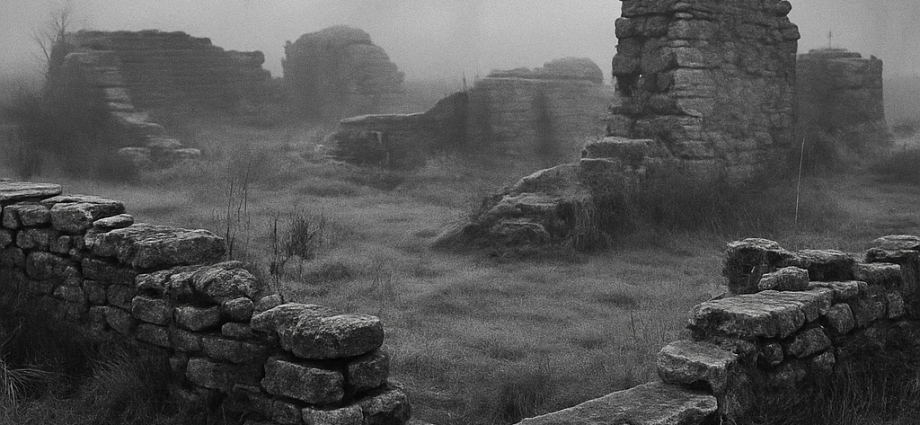
In the absence of answers, the village itself has become a ruin. The fields lie fallow, the cottages collapsed into mossy mounds. Travelers still avoid the site, muttering of whispers heard in the wind or shadows glimpsed between trees. Some say the village is cursed, that any who linger too long may themselves vanish.
What is certain is that Marrowfield’s disappearance left a scar. Neighbouring settlements carried the memory for generations, warning children never to wander off at night, lest they be “taken like Marrowfield.” The parish register ends abruptly with the year 921, names inked half a page, as though the scribe expected to return.
A village gone, its people erased, its story unresolved. Perhaps one day some relic will be unearthed—a chest, a letter, a skeleton—that will provide clarity. Until then, Marrowfield remains an open question in the Kingdom’s past: a reminder that history is not always a record of what we know, but also of what we have lost.