By Staff Correspondent, Provincial Bureau
If you travel far enough along the old southern road—past the vineyards gone to bramble and the mileposts no one bothers to repaint—you will eventually reach Evermere, a name that once suggested elegance and healing, and now means little more than ruins by a lake. There are no signs pointing the way anymore. You find it by accident, or by memory.
 The town sits in a shallow valley where the hills fold in upon themselves, cradling a lake the colour of pewter. A century ago, this place was the pride of the Kingdom: the Royal Mineral Baths of Evermere, where high society came to sip the waters, promenade beneath glass ceilings, and declare themselves cured of every ailment fashionable enough to require attention. The railway brought them by the carriage-load—dukes, dowagers, and dilettantes alike—each with a physician’s note and a sense of destiny.
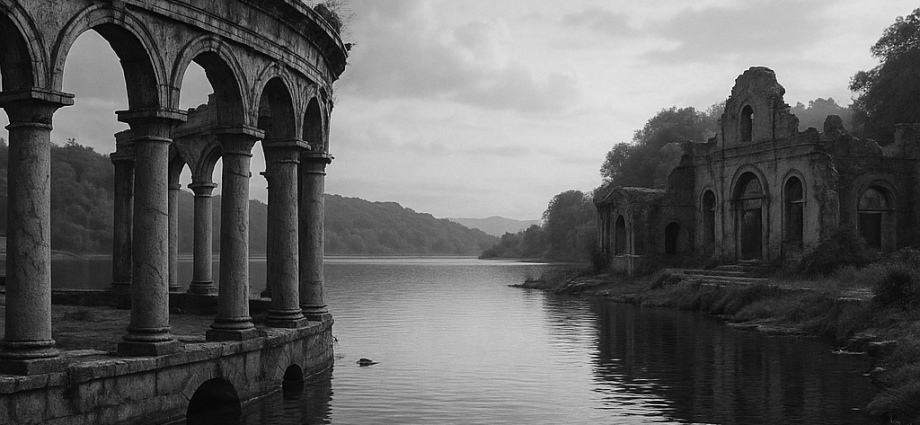
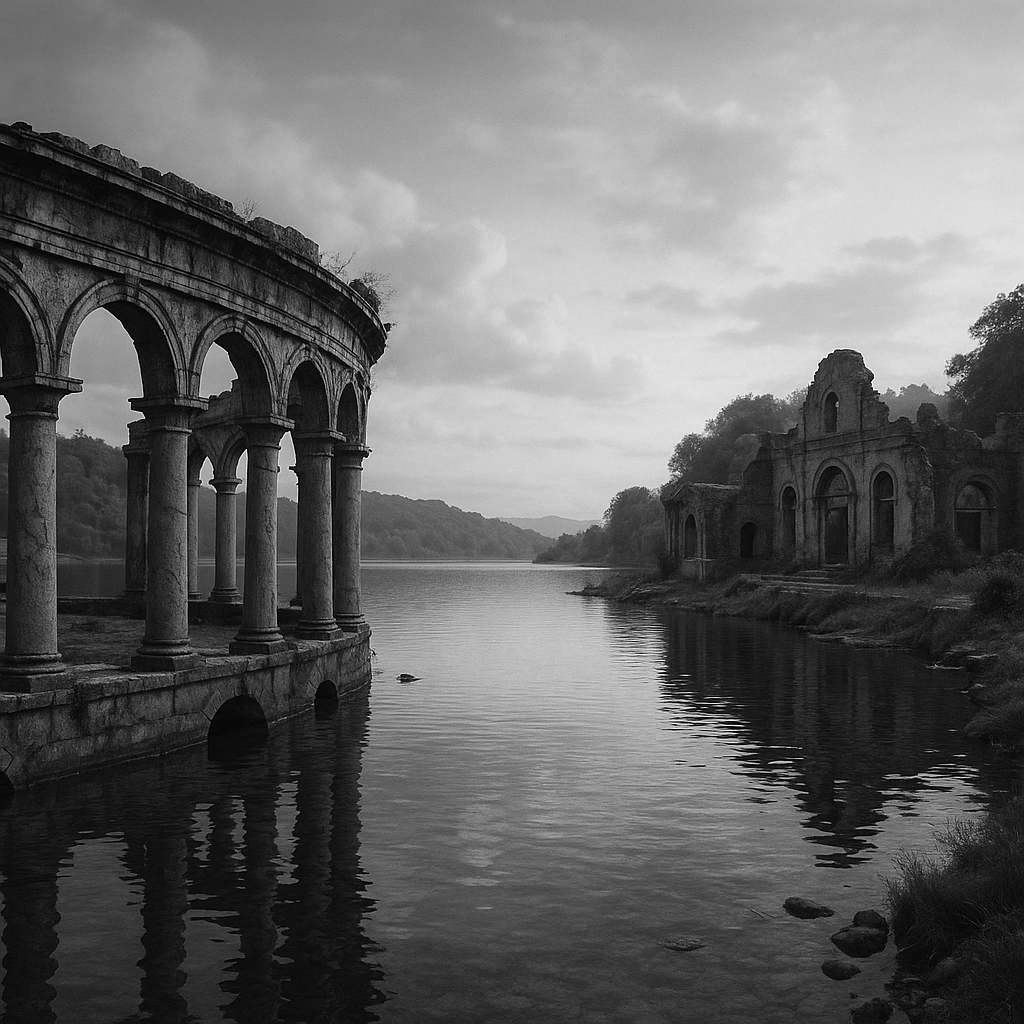
Now, the tracks are rusted, and the station clock has stopped at twenty-two past four. The only sound is the wind playing among broken shutters. The lake still lies calm, though no one bathes in it. The once-famous Grand Colonnade stands half-submerged, its marble columns tilted like teeth in an aging smile. Water drips perpetually from the arches into the pools below, forming rings that expand and vanish like unremembered applause.
It is difficult to imagine the glamour that once filled these halls. The archives of The Times-Observer describe carriages queuing for hours, fountains perfumed with rosewater, and orchestras performing waltzes while guests took the cure. “The waters of Evermere restore both complexion and composure,” boasted a 19th-century advertisement, illustrated with women in feathered hats gazing serenely into goblets of sulphur.
The waters still bubble faintly from the springs, carrying that same mineral tang—like coins left too long in the hand—but no one claims they heal anything anymore. The only regular visitors are the stonemasons who shore up the crumbling foundations “for heritage reasons,” and the occasional traveller in search of silence. The innkeeper of the last remaining guesthouse, a Mrs. Dallow, sums up the modern clientele with admirable concision:
“They come for the quiet, and they leave when it starts to talk back.”
She herself remembers little of the resort’s heyday, though her grandmother once worked in the tearooms. “Said you could tell a guest’s fortune by how they stirred their tea,” she tells me over breakfast. “Clockwise meant love, counter-clockwise meant regret. Most of them stirred both ways, which sounds about right.”
Beyond the town, paths lead through what was once the Bath Gardens, now a wilderness of ivy and echo. Statues lean drunkenly among nettles; benches collapse under their own sentimentality. Yet in certain light—particularly the pale gold of late afternoon—the place seems almost to remember itself. The shadows of vanished parasols fall across the lawns, and the broken fountains glimmer with reflections of nothing at all.
A small chapel still stands on the hill above the lake, its doors hanging open, its bell long gone. Inside, the walls bear the faint outline of frescoes depicting Saint Theodora of the Springs, patroness of both water and patience. Someone has placed a single candle on the altar; no one seems to know who keeps it lit. The wax has flowed and hardened into a shape resembling a tear.
In the evenings, mist rises from the lake and rolls slowly through the streets, softening every edge. The air smells faintly of salt and rain. A few cottages remain inhabited—fishermen, gardeners, one elderly clockmaker who insists on winding a dozen broken timepieces each night “to keep them company.” When I ask why he stays, he shrugs. “Some places just hold you. Like a dream that doesn’t end when you wake up.”
Evermere feels precisely like that: a dream half-remembered, too gentle to be frightening, too melancholy to be entirely comforting. Even the silence here seems deliberate, as if the town has chosen not to speak of what it once was. There are rumours that investors may one day restore the baths, though anyone who visits knows it would spoil them utterly. Decay has become their truest form of preservation.
On my last night, I walk down to the lake. The moon is reflected perfectly in the water, unbroken except for the occasional ripple of a fish or ghost. The sound of dripping echoes through the empty colonnade. Somewhere, a shutter bangs, and then even that falls still. I realise that I am the only guest left at the inn, and for the first time in many years, I understand what peace actually feels like: not comfort, but surrender.
The waters of Evermere no longer cure the body, but they have mastered the soul’s quieter afflictions. Here, amid the ruins, one learns to stop demanding answers from beauty—and simply to watch it fade, kindly, into itself.