By Staff Correspondent, Travel Desk
There are faster ways to reach the southern provinces, but none finer than the Golden Rail, that grand artery of steam and polish that carries the Kingdom’s citizens from Inverness to the green hills of Southmarch in just under nine unhurried hours. It departs from Platform Two of the Royal Terminus, a hall of brass columns and clockwork dignity where the scent of coal mingles with perfume and anticipation.
The journey begins not with speed but with ceremony. The conductor, wearing a cap sharp enough to slice butter, inspects the carriages with military gravity before announcing, “All aboard for Southmarch, the jewel of the low hills!” The passengers respond with murmurs of agreement, though most have made the trip dozens of times. Tradition demands enthusiasm.
 Once the whistle sounds, the train pulls free from the city like a thought escaping conversation. Inverness falls away—chimneys, rooftops, and all the anxious architecture of government shrinking into the haze—until only the fields remain, rolling gently as if sighing with relief.
Each carriage of the Golden Rail has its own personality. The first-class compartment glows with wood paneling and green velvet, its lamps trimmed in brass filigree. The dining car smells of tea and toasted bread, while the third-class benches, though austere, carry the most conversation per square foot in the Kingdom. Everyone, it seems, becomes sociable on a train. Even silence feels companionable here, punctuated by the steady rhythm of the wheels—an ancient lullaby that promises both motion and arrival.
Outside, the countryside begins its long parade: meadows mottled with sheep, rivers like ribbons of quicksilver, and the occasional windmill spinning with unhurried grace. Small villages drift past—each one dignified by its church steeple and inevitable pub named The Engine’s Rest or The Stoker’s Arms.
The first stop is Elmbridge, a pleasant market town whose chief exports appear to be strawberries and gossip. Vendors approach the platform windows selling paper cones of sugared fruit and the day’s scandal wrapped in yesterday’s news. At precisely the ninth minute, the whistle sounds again, and Elmbridge returns to the distance, its church bell tolling a farewell that no one on the train quite hears but everyone imagines.
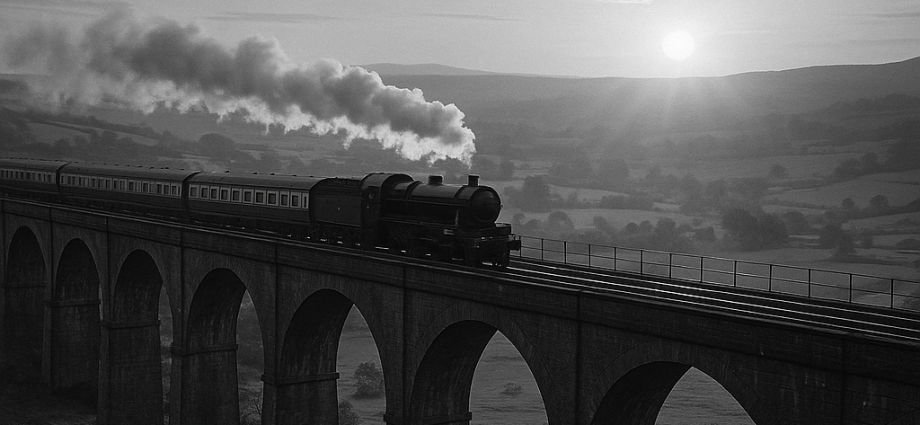
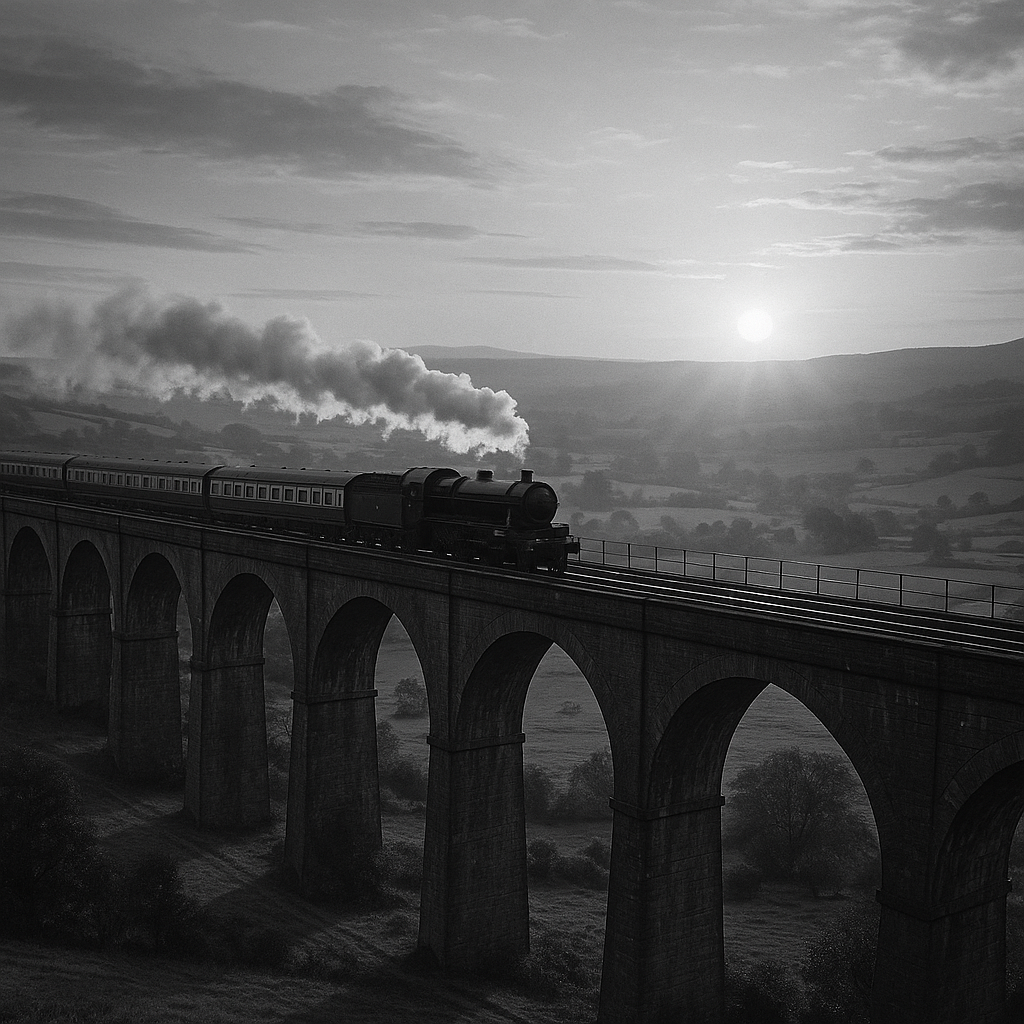
By the time we reach the Meadowcut Viaduct, the train is moving at full conversation speed—the speed at which strangers begin to share confidences. Opposite me sits a retired postmaster bound for Southmarch to visit his sister, and beside him, a young woman carrying a bouquet “for someone who deserves it, whoever that turns out to be.” She laughs when she says it, but not entirely.
Afternoon brings lunch: cucumber sandwiches, hard cheese, and tea poured from a pot that has seen more journeys than some monarchs. The steward—a man of remarkable balance—serves each table as the carriage sways. He recites the menu with the solemnity of a prayer:
“Roast fowl with mustard, cold beef with conviction, or the soup of the day, which remains undecided.”
The passengers applaud politely. In the observation car, one may stand on the small balcony and feel the wind press against one’s coat as the train sweeps through valleys thick with wildflowers. The air smells faintly of iron and honey. For all its machinery, the journey feels almost pastoral.
At dusk, the light softens to gold, and the rails themselves seem to glow—hence the name Golden Rail, or so the conductor tells me when I ask. “Though truth be told,” he adds, “it’s mostly the evening making a gentleman of the metal.”
The final stretch winds through the Southmarch Downs, where the hills rise gently, and the first hints of sea salt drift in from the southern winds. Children press their noses to the glass, counting sheep that turn into shadows as twilight deepens. Lamps are lit in the carriages, their reflections mingling with the stars just beginning to appear outside.
At last, the train slows with a hiss and a sigh into Southmarch Station, a building of arched windows and floral tiles, still bearing a sign that reads “Welcome to Tomorrow’s Countryside.” Passengers disembark with that particular dignity reserved for people who have travelled correctly—not swiftly, but properly.
As I step onto the platform, the night air feels warmer, gentler, touched by the scent of salt and lavender. The engine cools behind us, breathing softly like a beast at rest. The conductor raises his hat to no one in particular and disappears into the shadows.
Southmarch awaits beyond the gates—quiet streets, white cottages, and the sea beyond—but for now, the journey itself feels destination enough. The rails that brought us here gleam faintly under the moon, a path of light stretching northward toward the world we left behind, ready to carry us home again whenever we remember that not every adventure requires a war, a scandal, or even a reason—sometimes only a timetable and the willingness to watch the countryside go by.