By Industrial Correspondent, Inverness Bureau
There is a moment, somewhere past the fifth tunnel, when the scent of the countryside vanishes. The smoke of the train thickens, the sky turns the colour of tin, and the windows begin to rattle not from speed but from vibration. That is the moment one knows they have entered Glaston Quay—the Iron City, the beating anvil of the Kingdom of Eyehasseen.
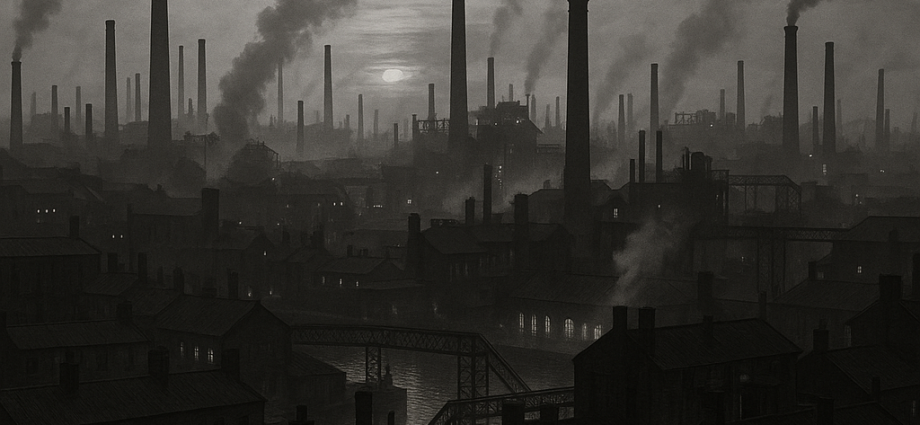
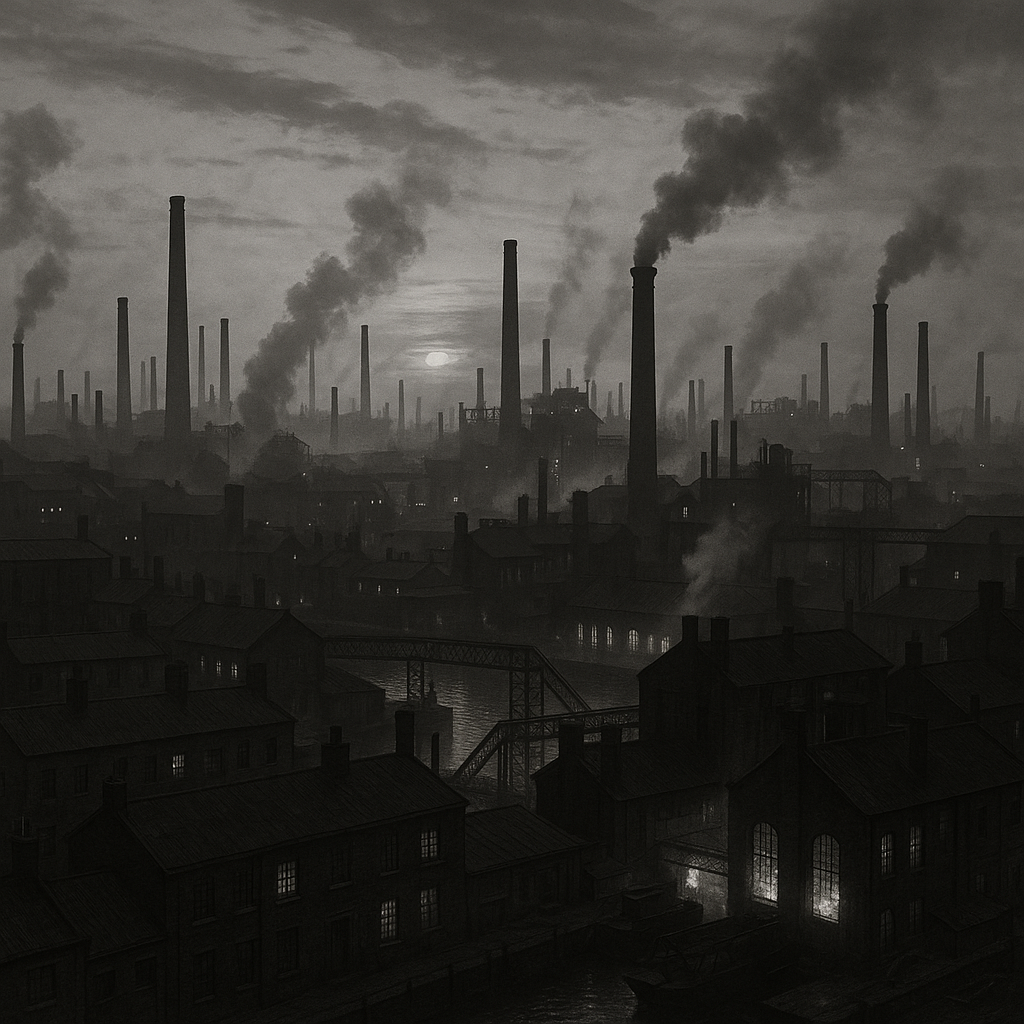 From a distance the city appears less a place than a phenomenon: a storm of chimneys rising above a maze of slate roofs, clouds of steam rolling like surf over the rooftops. The sound carries for miles—a steady metallic rhythm, the heartbeat of manufacture. Yet to step into Glaston Quay is to find order within the thunder, a strange harmony in the roar of creation.
The station itself resembles a cathedral to locomotion. Iron arches soar like gothic ribs, stained not with glass but soot. Porters hurry through the haze, their faces masked in a permanent half-smile of grit. Outside, the streets pulse with energy: carts laden with ore, barrels of oil, crates of rivets, and a thousand citizens moving to the tempo of industry. No one strolls here; they all advance as though pulled forward by invisible gears.
At the centre of the city stands Founders’ Square, dominated by the statue of Sir Edric Glaston, who supposedly discovered iron by accident while trying to bake bread in a furnace. The statue is perpetually dusted in grey, as though the city itself refuses to let him forget his legacy. Around the square, immense factories rise like fortresses, their windows flickering orange from the blast furnaces within.
A foreman named Ruthven Creel offers to guide me through the Quay Works, the largest foundry in Eyehasseen. We enter through a door the size of a drawbridge into a world of heat and hammering. Sparks leap like fireworks; molten metal flows through channels cut into the floor, glowing like captured sunlight. “This,” shouts Creel over the din, “is what keeps the Kingdom’s bones strong!”
Each worker performs their task with almost ritual precision. One hammers rivets, another adjusts the valves of a steam press. The air tastes of salt and carbon, heavy but alive. Despite the chaos, there is civility here—helmets tipped in greeting, mugs of tea balanced on anvils, a peculiar camaraderie forged by noise and necessity.
Outside the foundries, the city breathes in clouds. Narrow lanes wind between brick terraces, every window blooming with ferns trying valiantly to filter the soot. Children play beside puddles that shimmer faintly with oil rainbows. There is beauty even in the grime: gas-lamps shining through fog like coins dropped into water, and church bells whose chimes struggle but persist against the hum of turbines.
At noon, the sirens sound for the meal hour. The entire city pauses—machines sigh, pistons rest, and a collective exhale drifts across the rooftops. Workers gather along the canal banks to eat bread and boiled potatoes, their laughter echoing off the iron walls. “We make the smoke, but we breathe it too,” one tells me, breaking his loaf in half to share. “You learn to love it, same as weather.”
Beyond the industrial quarter lies the Merchant Canal, where barges heavy with ore slide through locks blackened by decades of labour. Here, women sort scrap by hand, singing work songs that have no beginning or end—only repetition, like the turning of gears. At twilight the canal glows with reflected furnace-light, and the city looks almost holy: a mechanical sunset in perpetual motion.
The Civic Council has lately begun discussing “beautification”—parks, ventilation towers, perhaps even electric lamps to replace the gaslights. Yet most residents seem content with the city as it is. “Progress smells like this,” says Creel, inhaling proudly. “If it ever stops smelling, we’ll know we’re in trouble.”
As night descends, I climb the observation stairs of the Royal Foundry Tower. From there, the entire panorama stretches before me: furnaces blazing, cranes swinging like enormous metronomes, trains gliding in and out like veins carrying blood. The city hums—a deep, steady music of pistons, steel, and human will. It is loud enough to drown thought, yet strangely reassuring, as though every clang is an oath of continuity.
When I finally depart by the midnight train, Glaston Quay recedes behind me in a plume of fire and mist. The carriages shake, the windows tremble, and for miles afterward the smell of iron clings to my coat. In the stillness between tunnels I realise that the city’s noise has become something like silence to me—so constant, so complete, that only its absence feels strange.
Glaston Quay is not beautiful in the ordinary sense. It is a beauty forged, not found—one that hammers its shape upon all who enter. And as the train carries me back toward quieter provinces, I suspect that, in some impossible way, part of me will always keep time to the rhythm of its eternal machines.