By Percival Bramble, Travel Correspondent
There are places in the Kingdom that resist explanation, landmarks that endure not because they are grand, but because they inspire a kind of collective reverence. The Stone of Everwatch is one such place. Rising from a lonely meadow near the edge of the Frostwood, it is not especially tall—perhaps three times the height of a man—yet its presence is undeniable. To stand before it is to feel the weight of centuries pressing quietly at your back.
The pilgrimage begins in the village of Greenhollow, a collection of cottages with smoke curling from their chimneys and a single lane leading into the hills. Every spring, villagers and visitors gather here to walk the five miles to the stone. The path winds through rolling pasture, across shallow brooks, and up into heathland where the wind seems to sing in the grasses.
On the day I joined, the procession was small: a dozen locals, a handful of curious travelers, and a priest from St. Oswin’s, his cassock trailing in the mud. At the head of the group walked Elswith Greave, a retired schoolteacher who has made the pilgrimage every year since childhood. “The stone watches,” she told me, “but it does not speak. That is its lesson. You learn by being silent with it.”
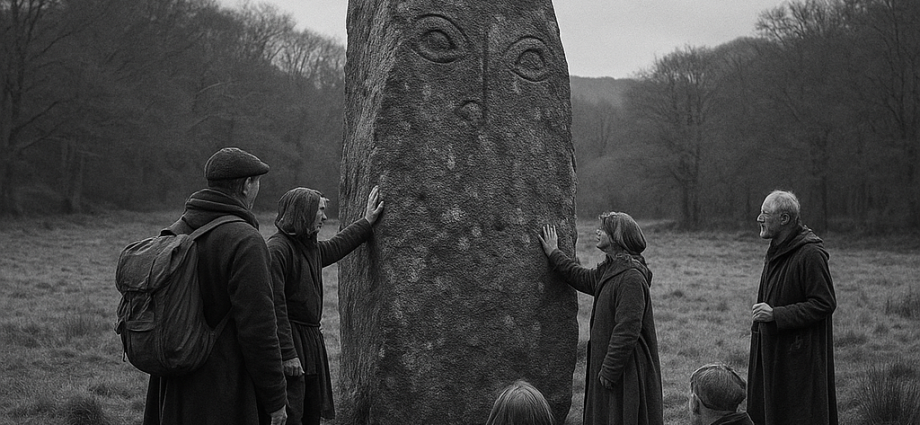
As we drew nearer, the stone appeared slowly on the horizon, a jagged tooth of granite thrust up from the earth. Its surface is etched with carvings, though no scholar agrees on their origin. Some say they are runes left by druids; others insist they are nothing more than the patterns of rain and lichen. From a distance, the markings resemble eyes—many eyes—gazing outward across the meadow.
We arrived at midday, the sun pale behind a veil of clouds. Pilgrims spread blankets, unpacked bread and cheese, and sat in hushed conversation. The priest knelt and prayed. A young couple touched the stone and whispered their vows anew. Children ran their hands along its cold surface, half frightened, half delighted.
I pressed my palm against it. The granite was rough, cool, and unyielding, but I felt a strange steadiness, as if the stone anchored not only the field but also my own restless thoughts.
Locals tell many stories of the Stone of Everwatch. Some claim it hums at night, audible only to those who keep vigil. Others insist it was a meeting place for warring clans who swore peace beneath its shadow. During the Storm Wars, villagers say soldiers rested at its base, leaving behind tokens still occasionally found in the grass: a buckle, a coin, a fragment of sword.
Elswith smiled as she recounted a tale passed down through her family. “They say a king once came here, uncertain if he should lead his people into battle. He sat at the stone until dawn, and when he rose, he knew what must be done. We do not know what answer the stone gave him—perhaps none at all. But he left with certainty.”
By late afternoon, the pilgrims began to drift away, their steps lighter than when they had come. Some left offerings at the stone’s base: wildflowers, a scrap of ribbon, even a crust of bread. As I departed, I turned back once. Against the grey sky, the stone loomed solemn and inscrutable, watching as it has for countless ages.
The Stone of Everwatch may never reveal its secrets, but perhaps that is its purpose. It does not explain, it does not instruct. It endures, and in its endurance we glimpse something greater than ourselves.