
By Eleanor Stowe, Senior Correspondent, The Times-Observer
In the wake of deceit, the Realm seeks order. Yesterday, beneath the vaulted ceiling of the Ministry of Information, a new Royal Charter was read aloud and sealed with the King’s own signet, establishing the Truthkeepers’ Guild—an association of licensed journalists, editors, and printers bound by oath to defend honesty in the public word. The Guild, the first of its kind, will stand as both a moral and practical bulwark against the contagion of falsehood that has haunted the Kingdom since the rise and fall of Rodger Bianchovi and his Red Banner.
A Charter of Conscience
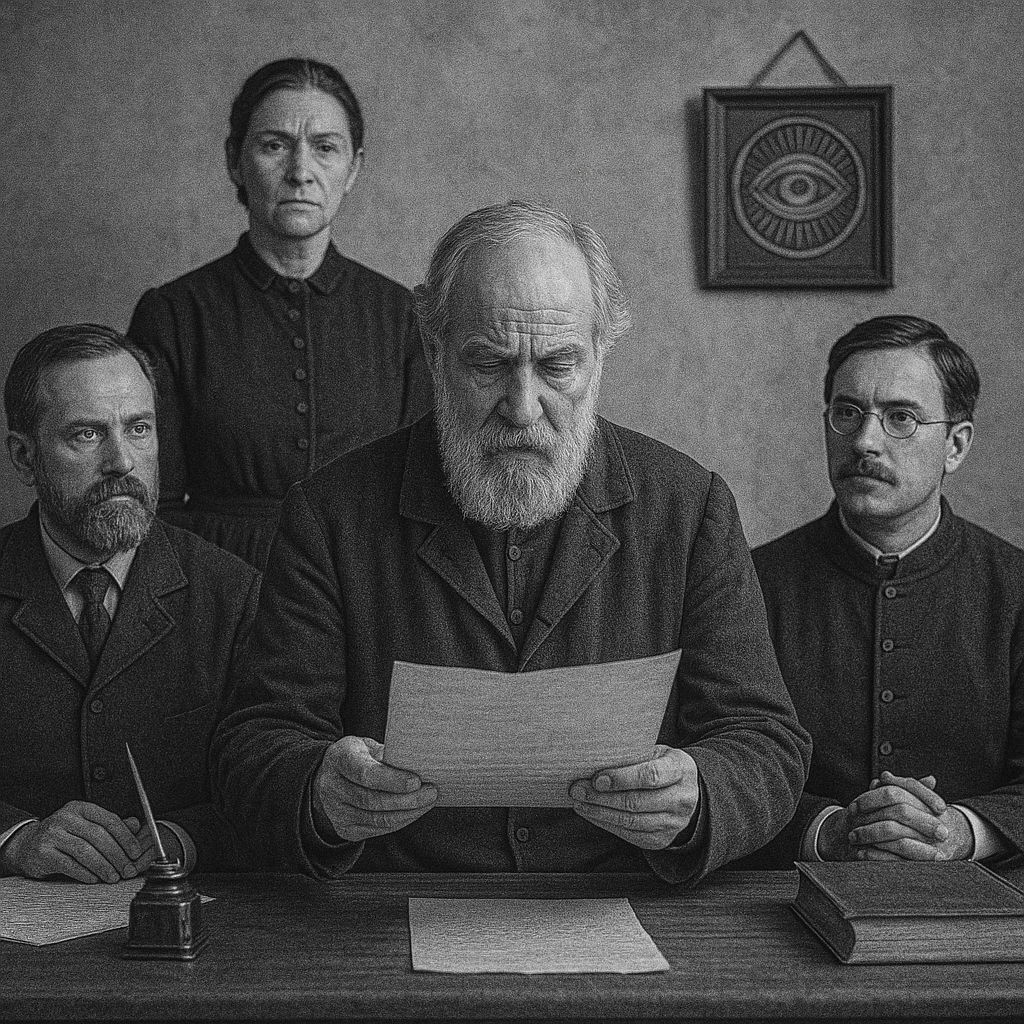 The ceremony was brief yet solemn. The Prime Minister, the Archbishop of Northmarch, and the Master of the Royal Press stood beside the Minister of Information as the parchment was unrolled. The opening line, drafted in the King’s own hand, drew murmurs from those present:
“Let it be known that Truth is not the property of power, but its duty.”
With those words, the Truthkeepers were consecrated into law. Under the Charter, no person may operate a public press, edit a periodical, or broadcast printed matter of political import without either Guild membership or certified exemption. Each member will take an Oath of Verity, pledging “to write no falsehood knowingly, nor twist truth for profit or ideology.” Perjury of that oath carries penalties equal to sedition.
The Structure of the Guild
At its head sits a Council of Nine, comprising senior editors, theologians, and public advocates chosen by both the Crown and the House of Ministers. Beneath them, each province will maintain a Chapter House, where apprentices may study the ethics and craft of reporting under masters approved by the Council.
Applicants must demonstrate proficiency in grammar, history, and civic law, and must produce three pieces of “verifiable reportage” as proof of integrity. Guild records will be open to inspection by the Ministry of Information but not by political parties or private patrons. “We are sworn to the truth, not to factions,” declared the newly elected Guild Warden, Master Felix Arlen, a grizzled editor once imprisoned for refusing to print propaganda during the border wars.
A Profession Redeemed
For decades, journalism in the Realm has occupied a precarious position—respected when sober, reviled when sensational. Bianchovi’s treacherous pen nearly destroyed it altogether. The new Guild aims to restore both discipline and dignity. “If the physician heals the body,” said the Archbishop during the dedication, “and the judge cleanses the law, then the writer must cleanse the word. The pen is a sacrament as well as a tool.”
Already, the first apprentices have gathered outside the Chapter House on Printer’s Row. One, a young woman named Marra Tenn, told this correspondent, “I want to write something that lasts longer than a lie.” Another, less poetic, added: “At least now there’s a ladder instead of a pit.”
Safeguards and Sanctions
The Guild Charter establishes strict oversight. Every publication will bear at its masthead a Mark of Verity—a seal indicating that the responsible editor is a Guild member in good standing. Should any article be proven willfully false, that editor must publish a full correction in equivalent space within a fortnight, or face suspension. Repeated offenses bring expulsion and permanent loss of license.
The Guild also introduces a Registry of Sources, kept confidential but reviewable by tribunal in cases of dispute. “An honest journalist need not fear to stand by his work,” said Warden Arlen. “Only the dishonest require shadows.”
A new disciplinary body, the Court of Candor, will adjudicate complaints brought by citizens who believe themselves misrepresented. Its verdicts will carry the weight of civil judgment, enforceable by the Ministry of Justice.
Reception Across the Realm
Reaction to the announcement was overwhelmingly positive. Crowds gathered outside the Ministry as the Charter was read aloud; copies were printed overnight and distributed to town halls and universities. The Herald of Whitehaven called the move “the rebirth of the Fourth Estate.” The Dockside Gazette, whose editor once faced trial for careless rumor-mongering, offered a wry headline: “At Last, an Editor You Can Trust (Under Penalty of Death).”
Not all are pleased. A small faction of pamphleteers protested that the Guild will stifle free expression. “Truth needs no license,” cried one speaker in the Market Square. Yet even he conceded that “a bit of discipline might do the trade some good.” The Constabulary observed the gathering but made no arrests.
The King’s Blessing
That evening, from the balcony of the Palace, the King addressed the citizens assembled below. His words were carried on lantern-light and recorded by the first Guild stenographers.
“Our enemies have used lies as arrows, but arrows break. The truth endures. Henceforth let no man doubt that the printed word in this Kingdom serves neither rebellion nor tyranny, but the people who read it.”
The crowd responded with a roar that rolled through the courtyards and down to the riverfront, where bells answered in echo. In that moment, the ink-stained profession—battered, humbled, and purified—stood renewed.
The Motto of the Truthkeepers
Engraved upon the Guild’s great seal are the Latin words Veritas Vincit—Truth Prevails. Beneath them, the motto in plain tongue reads:
“To write without fear, to speak without deceit.”
The presses of the Kingdom, long instruments of discord, will now bear that emblem. Whether it becomes merely a mark or a mission will depend, as the new Warden told his apprentices, “on the steadiness of our hands and the cleanliness of our ink.”