By Clarion Hask, War Correspondent, The Times-Observer
The Kingdom awoke this morning to the grim confirmation that the border conflict with Marelia has crossed from rumor to reality. Shortly after midnight, the Royal Signal Corps relay tower at Northreach Point, a vital link in the nation’s defense communications, was destroyed by a deliberate explosion. Officials now describe the incident as “an act of foreign-directed sabotage.”
The Tower in the Night
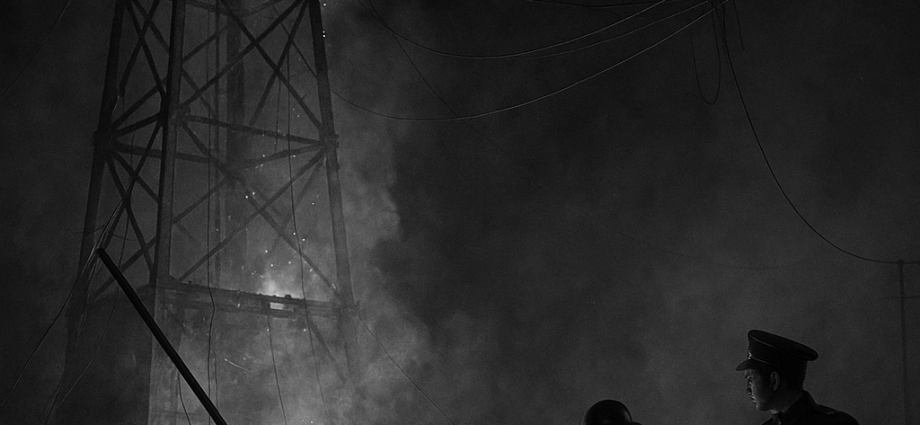
The Northreach Tower, a slender steel and stone structure overlooking the frontier plain, served as the chief repeater for coded telegraph and semaphore signals between the garrisons of the north and the Ministry of War. At precisely 12:14 a.m., residents of nearby Holmsgate village reported a “thunderous crack” followed by a pillar of flame.
Within the hour, the tower was a smoldering skeleton. Only its lower foundation remained intact. “We found the blast pattern facing east,” said Lieutenant Verne of the Signal Corps, his uniform still dusted with ash. “That means the charge was placed on the Marelian side.”
Investigators recovered three metallic fragments from the crater near the base — pieces of fuse and detonator caps bearing serial markings traced to a Marelian manufacturer of mining explosives. “You don’t need miners to knock down a tower,” remarked one Constable. “You need saboteurs.”
The Human Cost
Two watchmen, Sergeant Hale and Private Tomson, were on duty when the blast occurred. Tomson was found in the debris, badly burned but alive. From his hospital bed, he managed to describe “a low mechanical hum” moments before the explosion — possibly the approach of a Marelian drone-cart or automaton used to deliver the charge.
“The ground shivered like a train was coming,” Tomson whispered. “Then the light turned white.”
Sergeant Hale has not been recovered. His name has been added to the growing list of those presumed lost in the “undeclared war” now unfolding across the northern line.
Panic and Precision
By dawn, military telegraph lines were flooded with urgent dispatches. The Royal Army Command declared a Level Two alert, ordering reinforcements to secure all communication towers within fifty miles of the border. Temporary relay stations have been established using portable field masts and acoustic signal lamps.
“This is not panic,” said Colonel Varrin of the Palace Guard, addressing reporters at midday. “This is precision. Marelia has chosen to strike our nerves; we shall show them our spine.”
The Ministry of War released a map this morning showing the Kingdom’s entire northern communication chain now under double watch. All signal codes are being replaced; every operator must authenticate his identity by oathword and thumbseal before transmission.
Marelia Denies, Again
Predictably, the Marelian foreign office has issued a denial, claiming the explosion was caused by “defective equipment” and that any evidence of foreign components was “fabricated for propaganda.” The tone of the communiqué — haughty, even mocking — has done little to calm nerves in Inverness.
Meanwhile, crowds gathered outside the Marelian legation once again, chanting “Hands off our wires!” until Constables dispersed them near dusk. The envoy has refused to comment.
The Press Reacts
Across the nation’s newspapers, editorial columns bristle with fury. The Inverness Herald declares, “When the enemy strikes the wire, he strikes the word.” The Times-Observer’s own editorial notes that the act “marks a deliberate attack on the channels of truth itself, the very arteries of a civilized realm.”
In taverns and tramcars, speculation runs rampant. Some whisper that Marelia intends to sever communication before launching a full invasion. Others suspect internal betrayal. “No foreigner could have set that charge alone,” said a retired engineer overheard at the King’s Arms. “Someone here opened the gate.”
On the Ground
By mid-afternoon, this correspondent reached Holmsgate, a village still coated in soot from the blast. The air reeked of burned oil and iron. The tower’s twisted framework juts from the earth like a broken mast. Soldiers pick through the debris, their boots crunching on glass and melted wire. Nearby, a team of engineers hoists a temporary antenna.
“Give us two days,” said Captain Lorn, commanding the reconstruction detail. “We’ll have this line speaking again, louder than before.”
In a makeshift tent at the base, a blackboard bears the chalked words: “They tried to silence us. We answer in signal.”
The Whisper of War
The Prime Minister met privately this evening with the Minister of War and the Archbishop of Northmarch. Though no declaration of war has been issued, the tone is changing. An unsigned circular sent to government offices and regiments reads: “Prepare as though the declaration has been made, and you will not be surprised when it comes.”
At sunset, the bells of the Cathedral tolled seven times — once for each known victim of border violence since the River Nord incident. The chimes echoed across the city like a slow drumbeat of inevitability.
A Nation Holding Its Breath
The King has not yet spoken publicly, but palace sources confirm he has authorized “heightened readiness across all frontier commands.” The Palace Guard remains in ceremonial formation, but their eyes are fixed northward.
The River Nord lies silent again tonight, reflecting starlight like a blade. Yet in that silence, there is a sense that all of Eyehasseen — from palace to pasture — is listening for the next sound.
And when it comes, it may not be a signal. It may be a volley.