By Thaddeus Rook, Parliamentary Reporter, The Times-Observer
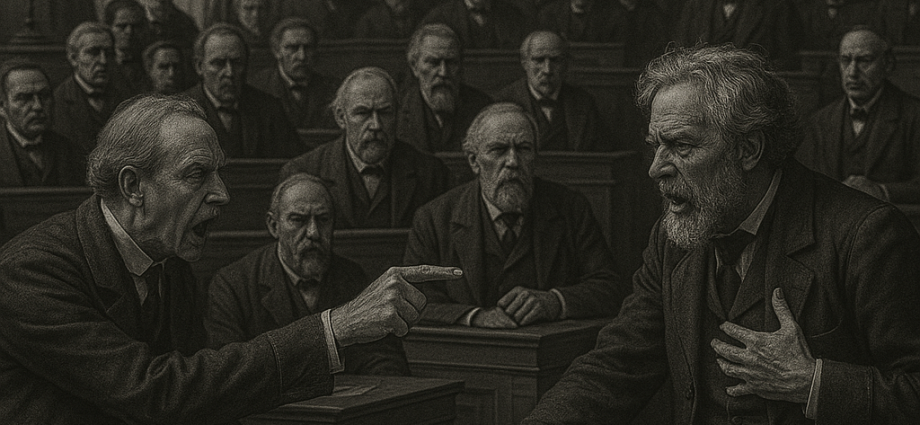
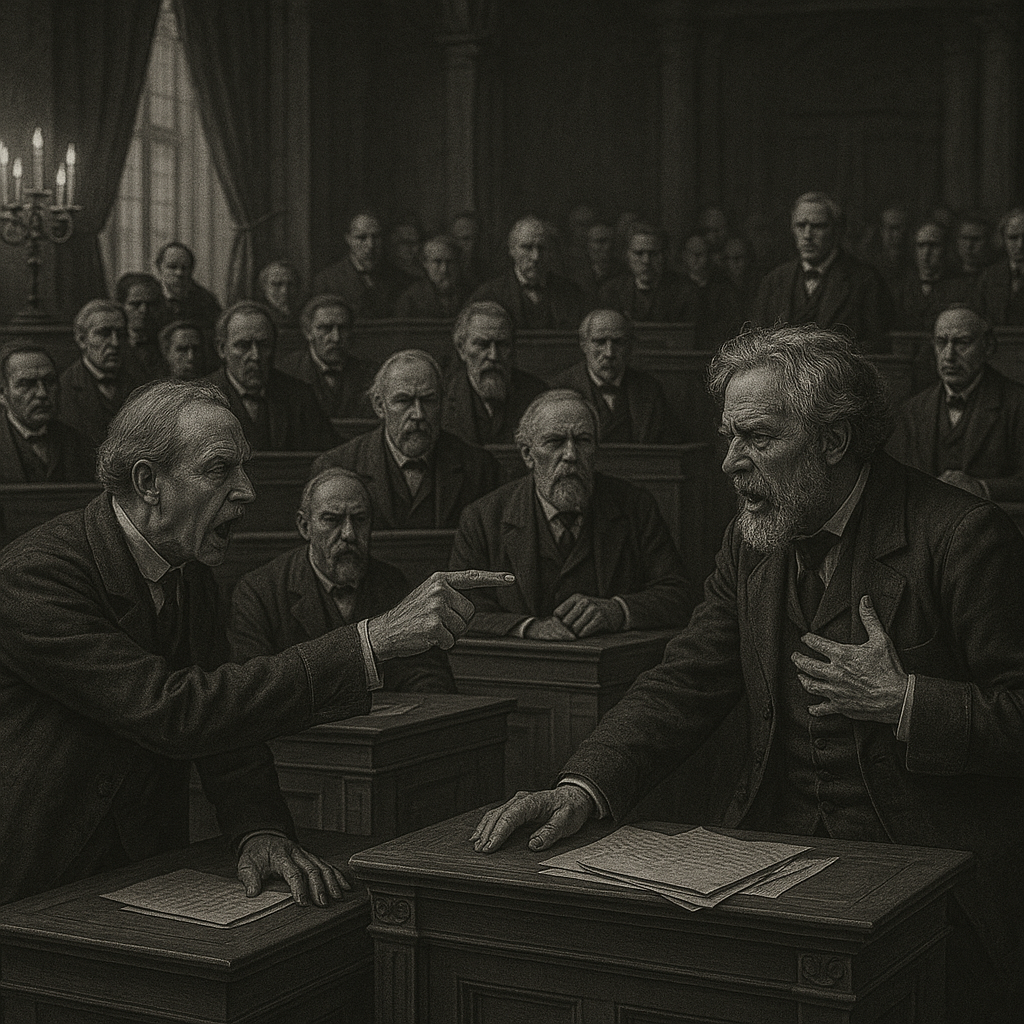 The Hall of Ministers seldom trembles. Built of old stone and older habit, it is a chamber that prefers the steady clack of quill on blotter to any sound resembling thunder. Yet thunder there was this week, as the Royal Assembly met to consider a question that touches every press and parish in the Realm: in the wake of Bianchovi’s crimes, who shall hold the reins of the printed word?
At issue was a single sentence in a proposed Reform Bill: whether ultimate oversight of public news, broadsheets, gazettes, and journals should remain with the Ministry of Information, whose charter speaks of “cultivating fidelity to truth,” or pass to the sterner custody of the Ministry of Justice, whose writ concerns “the prevention and punishment of harms.” Few laws hinge on a lone clause; fewer still set the benches ablaze. This one did both.
A House Divided by the Same Fear
Sir Alaric Thayne, Minister of Justice—imposing in black broadcloth and as spare with words as a prosecutor before the noose—rose first. “Ink is not neutral,” he began, voice echoing against the domed ceiling. “When sharpened into falsehood, it is a blade. When multiplied on a press, it is an arsenal. We have buried one man who wielded such weapons. We shall not wait to bury another.”
He laid out numbers like charges: thirty-two arrests in seven days; six clandestine presses seized; two suspected foreign financiers named in cipher. “These are not footnotes to a scandal,” he said. “They are articles of war.” The House murmured approval; several ministers thumped their canes.
Across the aisle, Lady Miren of the Liberal Faction stood with a measured calm that made her dissent the more cutting. “If words are weapons, so too are laws,” she said. “We do not hand swords to butchers because meat is difficult to carve. The remedy for a lying press is a better press, not a handcuffed one.” She argued that the Ministry of Information—reformed, audited, and strengthened—could guard the gates without turning them into prison bars. “If Justice takes the helm,” she warned, “the temptation to prosecute every quarrel of opinion as treason will prove irresistible to lesser men.”
The Prime Minister’s Middle Course
The Prime Minister—gray at the temples, habitually reluctant to step where tempers run hot—rose with the poise of a man balancing a ledger no one else can see. “Truth needs no permission, only protection,” he said, repeating the phrase that has already found its way onto tavern walls and schoolroom slates. He proposed a compromise: Information keeps the charter; Justice gains the teeth.
Under his scheme, the Ministry of Information would license printers, register mastheads, and publish weekly bulletins of rumor and correction—“to starve falsehood of oxygen.” But any finding of willful, coordinated deceit in aid of sedition would trigger an automatic referral to Justice, which could indict swiftly under a new crime: malicious fabrication for public harm. A joint tribunal—three jurists, two master printers of unimpeached standing—would adjudicate contested cases within ten days.
“It must be harder to lie than to tell the truth,” the Prime Minister concluded. “But not so hard to publish truth that we smother it.”
Galleries and Whispers
The galleries were full—clerks, tradesmen, students in ink-stained cuffs—leaning forward to catch each thrust and parry. From the west window benches came a low hiss when a backbencher proposed that all anonymous writing be banned outright. “Cowardice wears a mask,” he cried. “Let us rip it off.” A veteran correspondent in the gallery muttered, “And there goes half the wisdom of the realm.” The hiss became a laugh.
When Master Hollis of the Royal Printing Guild – summoned as an expert witness after the Guild’s recent embarrassments – took the bar of the House, he looked as if sleep and soap had both been rare in his week. “Printers are not priests,” he said hoarsely. “We do not absolve; we reproduce. Give us a lawful standard and we will meet it. Give us a swinging axe and men will print under the floorboards again.” It was as close to contrition as a guildsman can manage in public, and it landed.
Amendments at Sword’s Point
By afternoon the Bill had swollen with amendments: a requirement for public errata ledgers in every pressroom; obligatory corrections of material falsehoods within a fortnight or face fines; compelled space for rebuttal when the injured party is a public official or ministry; and a whistleblower shield for apprentices who report clandestine orders and falsified invoices—this last greeted by a rumble of approval from the trades.
Justice added its mark as well: asset seizure for presses proven to be instruments of sedition; banishment from the trade for proprietors who launder mastheads to evade sanction; and criminal liability for financiers who conceal ownership behind straw-men partnerships. “We will not again wrestle with shadows,” Sir Alaric said flatly.
Conscience, Courage, and Cost
In a rare intervention, the Archbishop of Northmarch (sitting today as a spiritual peer) reminded the House that “truth is a matter of conscience before it is a matter of compulsion.” He endorsed the compromise, with a sermon’s coda: “Make the righteous path straighter than the crooked one, not narrower.”
The Treasurer of the Realm then rose with unwelcome arithmetic: expanded registries, inspectors, tribunals, and provincial bulletins will cost “a modest sum now, or a dear sum later if we fail.” He proposed a levy—one aureal per ream—dedicated to the Truthkeepers’ Fund that would pay for audits and the upkeep of seized equipment repurposed for civic printing. The benches groaned, then nodded; even principle needs paper.
The Vote and the Vein of the Nation
At last the division bells rang. Members filed through the doors beneath the painted motto Veritate et Fide—By Truth and Faith. When they returned, the tellers announced the count: the compromise carried by a stout majority. The Hall exhaled.
Outside, dusk pooled in the colonnades. Newsboys took the first shouted summaries to the streets, and the city’s lawful presses—our own among them—set fresh type. It is fashionable to say the Assembly dawdles until danger has passed. Not today. Today it found a line the Kingdom might walk: sharp enough to cut treason, broad enough to carry truth.
Whether the line holds will depend, as ever, less on parchment than on men. The law may now punish the liar. It remains for the honest to speak—and to print—with courage.