By Aldus Penwright, Senior War Correspondent, The Times-Observer
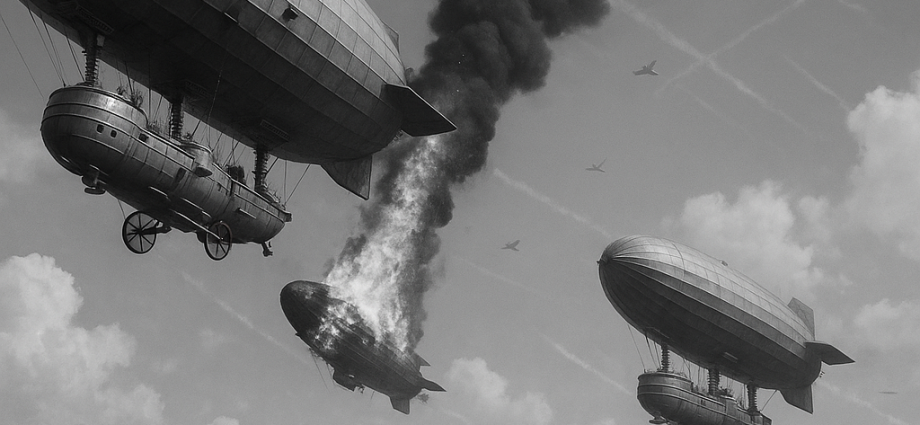
The war that began in mud and hedgerow has now risen into the heavens. Yesterday’s Battle of the Southern Skies marks the first great air engagement of the conflict—a stunning triumph for the Royal Air Fleet of Eyehasseen, whose gleaming dirigibles and clockwork fighters turned the Marelian armada into drifting wreckage over their own plains.
It was war not as our fathers fought it, but as the new age demands it: silent at first, then sudden with thunder.
The Morning Ascent
At dawn, the Sky Dreadnought Resolute led a squadron of six airships and a dozen steam-propelled fighter craft south from the fortress of Thornwold Aerodrome. They ascended through silver fog, their propellers slicing clouds like scissors through silk. The plan, devised by the Royal Aeronautical Corps, was bold but simple—draw the Marelian fleet out from their hidden hangars at Galdin Vale, then strike from altitude before their gas cells could rise to parity.
At 09:16, the Marelian ships appeared, fifteen in number, black-bellied and broad-winged. Observers on the ground reported the sight “as of two schools of whales colliding in heaven.”
The Clash
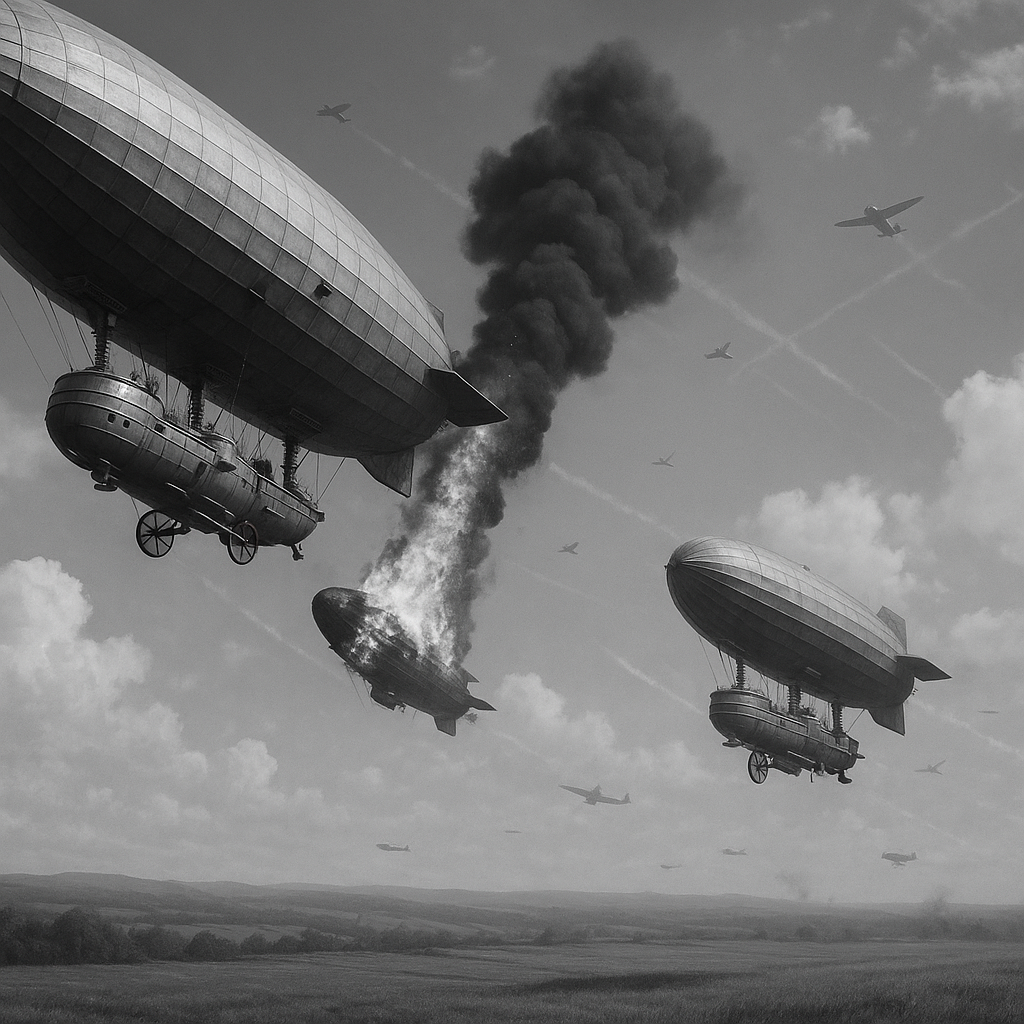 The first volley came from the Resolute, whose broadside steam cannons sent hissing shells through the upper atmosphere. The Marelians returned fire with magnesium flares and primitive rockets—spectacular but wildly inaccurate. The air filled with glittering debris, ribbons of smoke, and the echo of engines straining like beasts.
Within minutes, the Kingdom’s smaller interceptor craft—sleek, brass-bodied flyers known colloquially as “Hawks of Thornwold”—cut through the Marelian formation, igniting hydrogen sacks with incendiary lances.
By 10:00, four Marelian vessels were aflame, their carcasses spiraling downward through clouds that flashed orange and black. Survivors were seen parachuting into their own countryside. The remaining ships turned tail, trailing banners of smoke.
The Cost
Though the battle was a decisive victory, it was not bloodless. The Airship Valiant suffered a ruptured steam conduit and was forced to land behind friendly lines. Two pilots of the 3rd Air Squadron were lost when their flyers collided in cloud. Their comrades circled the wreckage in formation before descending—a silent salute visible even from the ground.
A single telegram, issued by the Minister of War, read:
“The skies above Marelia are once again ours. Their arrogance has fallen to earth.”
Witnesses on the Ground
From the border villages below, farmers and refugees watched the battle unfold like a moving constellation. “It was the most beautiful thing I never wished to see again,” said Eamon Kell, a blacksmith from the town of Derenfeld. “They fought above us like angels quarreling over the world.”
Children cheered each plume of descending smoke, mistaking destruction for fireworks. One boy was heard shouting, “We’ve caught the clouds!”
Strategic Implications
Military experts call the victory “the turning of the tide.” Marelia’s air fleet was their pride—both symbol and strategy. Their remaining ships are now believed grounded for repair, their crews demoralized. The Royal Air Corps has established dominance from the Northern Marches to the Southern Plains.
Yet the Ministry of War cautions restraint. “Air mastery is not war’s end,” said Colonel Varrin. “It is its ceiling.”
Nevertheless, morale across the Kingdom soars as swiftly as the airships themselves. Factories in Westmere have tripled output of boiler plates and aerial munitions. The Royal Conservatory has even announced special scholarships for engineers “who can design peace through mastery of the air.”
The King’s Words
At sunset, the King addressed the nation from the Palace balcony:
“Our sons and daughters have taken the war beyond reach of lies. Let Marelia look upward and see what truth looks like with wings.”
Crowds gathered in the city squares, faces upturned, as the Resolute returned home trailing victory pennants. Searchlights swept the sky in salute, tracing silver beams against the dusk.
The bells of every cathedral rang ten times—for the hour, and once more for the triumph.
A New Symbol
Already, artists and poets speak of the battle as the “Dawn Above Marelia.” A poster commissioned overnight by the Ministry of Information shows a single airship rising through clouds, the caption reading: “Guardians of the Skies — Eyehasseen Prevails.”
Whether this marks the midpoint of the war or its beginning, none can say. But for the first time since the opening volleys, the Kingdom looks not to its borders, but upward—toward a sky cleared by courage and filled with the scent of steam and victory.