By Rowan Hale, Investigative Correspondent, The Times-Observer
The western shipping lanes of Eyehasseen are stirring again today as teams from the Royal Corps of Engineers begin a full-scale reconstruction of the Lower Westmere Docks, following what officials now confirm was a deliberate sabotage attempt carried out under cover of night earlier this week.
The incident, initially reported as an “accidental structural failure,” has since been reclassified after investigators uncovered conclusive evidence of “intentional tampering with load-bearing infrastructure.” Though the culprits have not yet been identified, the Ministry of the Populi has suggested that the attack was likely coordinated by radicalized remnants of the now-dispersed socialist cells or Marelian nationalist agitators seeking to undermine post-war recovery.
No injuries were reported, but damage to the docks was significant enough to halt all commercial unloading for two days — an economic blow softened only by the swift mobilization of military engineers.
A Collapse That Should Not Have Occurred
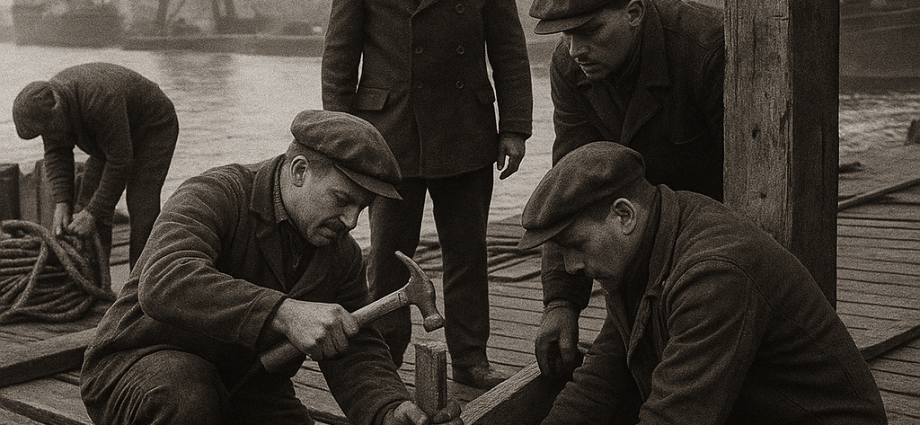
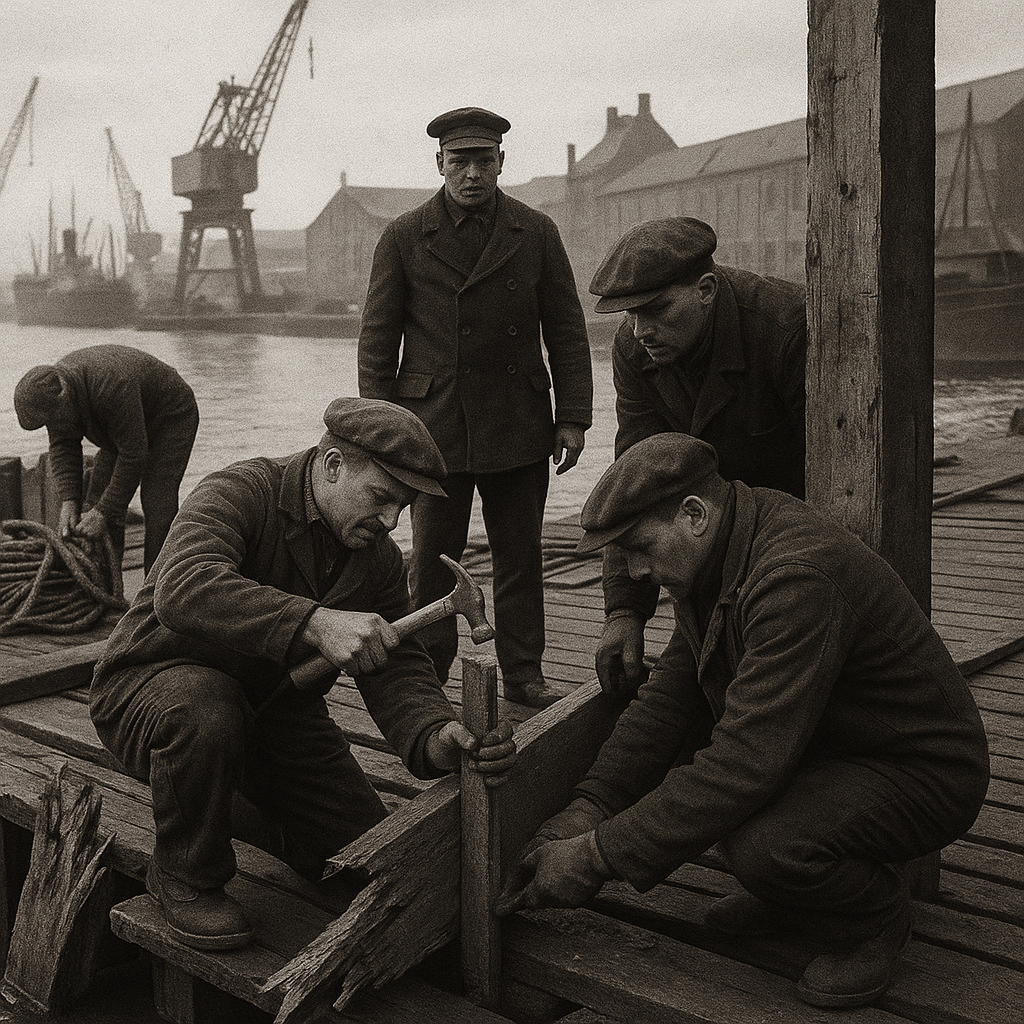 According to Chief Structural Examiner Lora Kendrin, the collapse of the southern pier section was “precise, controlled, and unmistakably engineered.” She explained that three support beams had been weakened in the exact same manner: carved at their joints and painted over to conceal the cuts.
“Nature doesn’t do this,” she said. “Tools do. Knowledgeable tools.”
Witnesses reported hearing a sharp crack around the fourth hour of night, followed by the groaning fall of timber into the tide. By the time watchmen reached the site, whoever had caused the damage had vanished—though constables did find footprints on the sand leading toward the warehouse district.
Economic Stakes High as Trade Reopens
The Lower Docks serve as a primary artery for incoming grain, timber, and salt-fish shipments from the coastal wards. With Marelia’s blockade lifted, Eyehasseen has finally begun restoring its pre-war shipping schedule.
“This attack was intended to choke the Kingdom right as trade was returning to normal,” said Minister Corwell. “We’ll not allow saboteurs—foreign or domestic—to drag us backward.”
Temporary piers and floating platforms have already been installed to maintain cargo flow. The Royal Navy dispatched two patrol boats to guard the waters until the investigation concludes.
Engineers Work Around the Clock
At dawn today, nearly fifty engineers from the Royal Corps assembled with lumber, rope, stone, and the signature green-coated precision tools of their trade. Their commander, Major Elric Thornwright, surveyed the damage with grim efficiency.
“It’s clean work,” he said, pointing to the carved beams. “Too clean. Whoever did this has practiced.”
When asked whether Marelian agents might be responsible, Thornwright shook his head.
“Might be them. Might be radical socialists. Might be smugglers with a grudge. At this point, we’re dealing with cowards who strike at wood because they dare not strike at soldiers.”
The reconstruction effort is expected to take five days, during which the docks will remain partially operational.
Whispers in the Warehouse District
Constables patrolling the nearby alleys have reported unusual activity in recent weeks—late-night lanterns seen through shuttered windows, strangers renting storage units under false names, and an uptick in coded correspondence intercepted by the Truthkeepers.
One officer, speaking on condition of anonymity, said:
“Someone’s trying to organize something down here. We don’t know who yet. But it feels like the same rot we saw during the war.”
No arrests have been made, but several individuals are being questioned.
Local Reaction: Unease, but No Panic
Dockworkers—many veterans of the Marelian War—expressed anger that their workplace had become a target.
“They won’t scare us off,” said Harl Murren, a stevedore who witnessed the aftermath. “We rebuilt after the war. We’ll rebuild this before supper.”
Merchants remain cautiously optimistic. One fishmonger waved a gutted cod at our reporter and proclaimed, “You can’t sabotage the sea! We’ll keep trading until the tide stops coming in.”
The sentiment in Westmere seems to be one of irritation rather than alarm—a sign of a Kingdom growing harder to intimidate.
King Edmund Briefly Addresses the Incident
In a short statement from the Palace, His Majesty declared:
“Peace is not simply the absence of battle, but the steadfast repair of what malice attempts to break. The saboteurs will be found. The docks will be restored. And the Kingdom stands unshaken.”
The King praised the engineers’ rapid mobilization and assured the public that Eyehasseen’s infrastructure remains “secure, resilient, and under vigilant protection.”
A Kingdom That Rebuilds Faster Than It Breaks
As hammers ring against timber and new beams rise against the morning sky, the docks buzz with determination. The saboteurs may have cut the beams, but it is the people of Eyehasseen who set them upright again.
In a Kingdom tempered by war and awakened to the dangers of lies and shadows, even an act of sabotage becomes not a victory for the enemy—but a reminder of the Kingdom’s resolve.