By A. T. Merriman, Times-Observer Historical Correspondent
Few chapters in the annals of Eyehasseen’s maritime history gleam with such daring, blood, and consequence as the long and violent struggle between the Crown and the sea-wolves who once ruled the coastal waters of the realm. From the late 700s through the early 800s of the Kingdom’s reckoning, piracy plagued the southern coasts, particularly the straits and reefs that came to be known as the Iron Shoals. For near a century, those treacherous waters were both the highway of commerce and the hunting ground of cutthroats, smugglers, and exiled seamen who flew banners of their own invention.
It was there that the fortunes of the Royal Navy were tested and transformed—there that a young lieutenant named Captain Alaric Dane rose to legend, and there that the last and most infamous of the corsairs, Black Garrick Trenloe, met his fate.
The Age of the Free Seas
Before the Royal Navy became the disciplined and iron-willed instrument of the Crown that we know today, it was a looser confederation of coastal patrols and merchant guards, drawn from noble sponsors and local shipowners. The seas around Eyehasseen—especially the Crescent Bay and the eastern approaches to Valenreach—were riddled with islets, channels, and fog-cloaked inlets where a ship might hide unseen for weeks. Merchantmen bound for Northreach, Thornwold, or the wine ports of Marelia had to pass these dangerous coasts, and few did so without paying tribute to the self-styled “Sea Lords.”
The earliest records speak of Captain Veylan of Braydon Fields, an ex-naval man dismissed for insubordination who turned to raiding the very convoys he had once escorted. He was soon joined by a rogue’s gallery of like-minded men: Red Marston, a disgraced privateer; “Old Peg” Henslowe, who built floating forts from lashed-together hulks; and Trenloe, then only a deckhand with a knack for mutiny. They divided the coast into “reaches,” as though carving a kingdom of their own. Villages along the shore were coerced into silence, and even minor nobles in the south were rumored to profit from their spoils.
By the reign of King Hadrian III, piracy had grown into a scourge upon the national conscience. Insurance rates soared, shipyards declined, and foreign powers mocked Eyehasseen’s impotence at sea. When the merchant vessel Celandine was seized off Goldvale in 807, her crew executed and her cargo burned, the Crown resolved to act decisively.
The Making of a Sea Wolf
Enter Alaric Dane, son of a shipwright from Cairndale, whose naval career had begun in the humblest berth imaginable as assistant purser aboard the Resolute. He was said to have read every manual of gunnery and seamanship in the Navy’s archives and could calculate tides in his head faster than most navigators with their charts. Dane first distinguished himself during the Night of the Black Squall, when, as acting lieutenant, he took command of a crippled sloop and saved three convoy ships from certain capture by Red Marston’s raiders.
Promoted to captain at the unheard-of age of twenty-eight, Dane was given command of a new frigate, HMS Valiant, a 38-gun beauty built at the Highmere yards; sleek, copper-bottomed, and armed with the latest long nine-pounders. His orders were simple: clear the Iron Shoals.
But nothing was simple about those waters. The Shoals were a labyrinth of coral and kelp-choked channels, where the winds died suddenly and currents pulled against reason. Even the charts were unreliable. Dane’s first patrol lost two cutters to hidden reefs and nearly the Valiant herself, were it not for his uncanny feel for the sea. “The man sails by instinct,” wrote one of his lieutenants, “as though the water tells him her secrets.”
The Pirate Confederation
By then, the pirates had formed a loose brotherhood under Black Garrick Trenloe, who had murdered his former captain and seized his brig, the Widow’s Bite. Trenloe was a dark, sardonic man said to have come from respectable stock in Westmere, though any trace of gentility was long washed away by blood and rum. His right hand was a woman called Mira Coln, known among sailors as the “Scarlet Compass,” who could navigate by stars invisible to other men. Together they ruled the Shoals from a hidden port on the isle of Lorn, where taverns hung the severed figureheads of captured ships as trophies.
Trenloe despised Dane personally. When word reached him that a young officer was bent on exterminating the Brotherhood, he sent a taunting message nailed to a drifting spar:
“The sea belongs to no king. Let him who claims it come and drown for proof.”
The Battle of the Burning Reefs
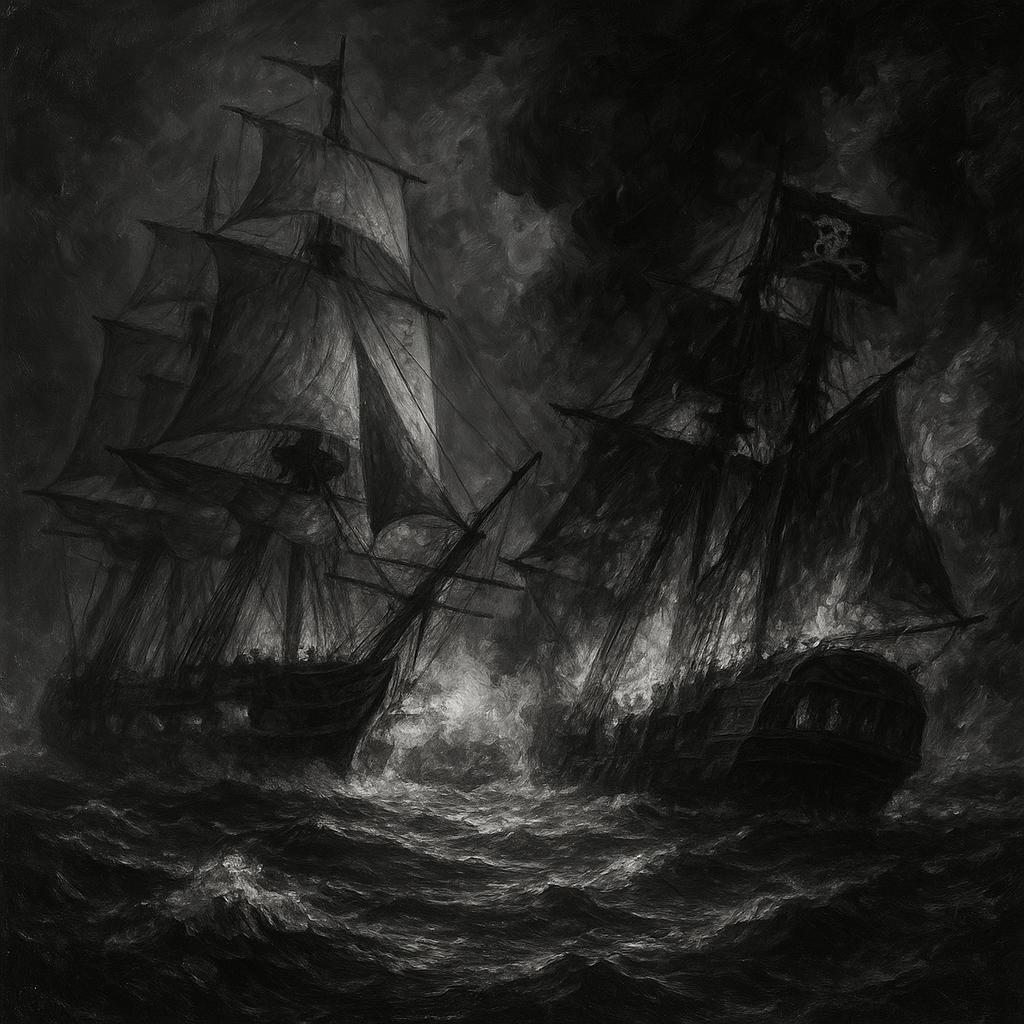 Dane’s first engagement with Trenloe came in the summer of 809. Acting on intelligence from a captured smuggler, he learned that the pirates had assembled a fleet of seven ships near the Burning Reefs, a volatile stretch where gas vents caused the water to shimmer with fire at night. Dane led the Valiant and two smaller frigates, Northwind and Courageous, into those perilous waters at dawn.
The battle that followed became legend. The pirates, anchored in a crescent formation, unleashed their cannon as the Valiant approached – but Dane, using the morning glare to blind their gunners, held his fire until the last possible moment. Then, swinging broadside at less than fifty yards, he gave the order: “Run out and fire as she bears!”
The first salvo tore through the Widow’s Bite, killing her helmsman and crippling her rudder. The air filled with smoke and shrieks. One pirate ship, the Doomlight, exploded when her powder caught flame; others ran aground or fled. The battle is famously depicted in Salvadore Winslow’s epic oil painting The Battle Against the Pirates.
Trenloe himself escaped, wounded but alive, vanishing into the maze of islands. When the smoke cleared, the Valiant had taken heavy damage but remained afloat—while five pirate ships burned to the waterline. The battle broke the back of organized piracy, though pockets of resistance remained for years.
King Hadrian rewarded Dane with a knighthood and command of a full squadron. Yet the captain took no pleasure in court honors. “The sea is never truly rid of vermin,” he wrote in a letter to his father. “It only hides them until the wind changes.”
The Hunt for Trenloe
For the next three years, Dane waged a relentless campaign of patrols, raids, and blockades. He established fortified signal stations along the coast and trained his men in night gunnery and semaphore—innovations that would later become standard practice. He earned the loyalty of his crews by sharing their rations and taking the first turn on deck during storms.
Trenloe, meanwhile, became a phantom. He struck without warning, seizing isolated vessels and disappearing before pursuit could be organized. His legend grew darker: he was said to leave a single black coin on every captured ship, a token of contempt for the Crown. Some claimed he had turned to witchcraft, others that he had bargained with Marelian merchants to fund his revenge.
In 813, Dane finally received credible intelligence that Trenloe was rebuilding his strength on the outer isle of Lorn. Gathering his squadron under cover of night, he sailed through a rising storm that would have driven lesser men to harbor. The Valiant’s masts bent near to breaking, but the captain held his course, guided by flashes of lightning that lit the jagged coastline.
When dawn came, the squadron found the pirate fleet at anchor—three ships, including the rebuilt Widow’s Bite. Trenloe, ever the showman, had raised a black standard bearing a crown split in two. He opened fire first.
The Duel at Sea
The ensuing battle, known in song as The Duel of the Two Captains, lasted six hours. The Valiant exchanged broadsides with the Widow’s Bite until both ships were shattered wrecks. At last, locked together by tangled rigging, the two captains met face-to-face on the heaving decks. Accounts differ as to their final words, but a midshipman later swore that Trenloe laughed as he drew his cutlass and shouted, “Let’s see if your King bleeds saltwater too!”
They fought in driving rain, blades ringing amid the roar of waves and cannon. Dane, though wounded twice, parried the pirate’s thrust and struck him down. The Widow’s Bite, aflame, began to sink beneath them. Dane’s men dragged their captain back aboard the Valiant moments before the pirate ship disappeared into the boiling sea, carrying Black Garrick Trenloe to his grave.
Only one relic of the pirate’s reign survived: his black flag, hauled aboard the Valiant and later presented to the King. It still hangs, faded but proud, in the Royal Maritime Museum at Inverness.
The Aftermath
With Trenloe’s death, the Iron Shoals fell silent. The remnants of the Brotherhood scattered to foreign ports or were captured and hanged at Fort Eldermoor. Merchant trade revived, and Eyehasseen entered what historians now call the Age of Maritime Dominion. Captain—now Admiral—Alaric Dane oversaw the construction of a permanent naval base at Northreach and established the Order of the Sea Cross to honor sailors who had fought in the campaign.
Yet even in victory, the admiral remained haunted. In his later journals, he wrote:
“The sea is a mirror that never lies. Look long enough and one sees not only the enemy, but the reflection of one’s own cruelty.”
He retired to a quiet estate in Cairndale, where, it is said, he could hear the waves from his garden. He never married, and when he died in 829, the King ordered that his coffin be draped in both the White Ensign of the Navy and the captured flag of the pirates he had destroyed.
Legacy of the Iron Shoals
Today, sailors still speak of ghostly lights over the reefs on stormy nights—the “fires of Trenloe,” flickering where the Widow’s Bite went down. Some claim to hear the faint thunder of guns in the distance, as though the battle still rages beneath the waves. Superstition aside, the campaign of the Iron Shoals reshaped Eyehasseen’s destiny. It forged a navy of discipline and courage, one that would later defend the realm through wars with Marelia and Valenreach alike.
In the grand halls of the Royal Navy College, a portrait of Admiral Dane stands beside that of King Hadrian III. Beneath it, carved in oak, is his personal motto:
“Order upon the sea is the freedom of the land.”
And so it remains that the tale of Alaric Dane and the pirates of the Iron Shoals endures—not merely as a story of muskets and sails, but as a testament to the eternal struggle between chaos and law, and to the men and women who, against all odds, chose to steer toward the storm rather than flee from it.