by Health and Fitness Staff
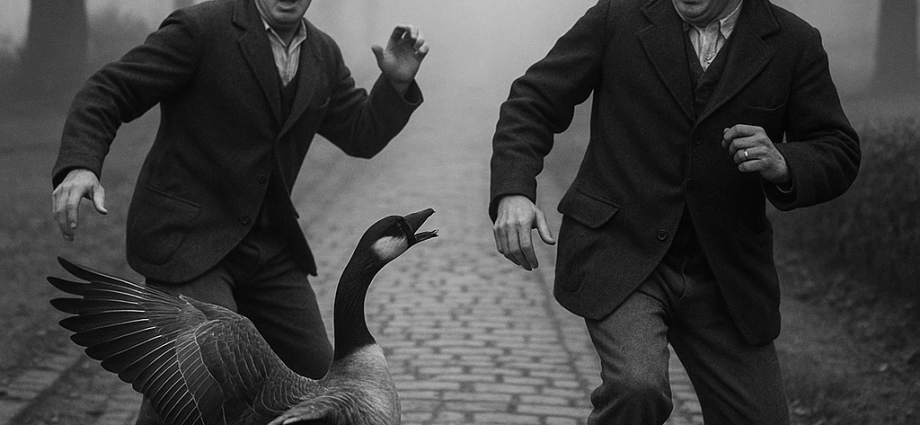
For most of the year, the Kingdom’s geese mind their own business — honking aimlessly, drifting across millponds, and occasionally blocking footpaths in self-important clusters. Yet an uptick in abrupt citizen startlements has prompted the Ministry of Health to classify a new condition: Goose-Induced Panic Strain (GIPS).
GIPS, according to the Ministry’s press briefing, arises when an unsuspecting person encounters one of the Kingdom’s notoriously territorial waterfowl and reacts with an instinctive, full-bodied spasm of alarm. Symptoms include spontaneous sprinting, awkward shouting, flailing of shopping baskets, and declarations such as “I didn’t bring bread! Why do you assume I brought bread?”
Rural clinics have seen a surge in shoulder sprains, lower-back twinges, and bruised shins. “The geese don’t technically attack,” said Dr. Roderick Hale of Eastreach Infirmary, “but they do give what we might call a ‘meaningful glare.’ Many people interpret that glare as an imminent act of violence and respond accordingly.”
Earlier this month, a bookkeeper from Inverness toppled directly into a hedgerow after a goose emerged from behind a public bin. “It hissed,” the bookkeeper insisted. “A real, pointed hiss. The kind that says: ‘I know exactly where your ankles are.’”
Wildlife stewards offer a different interpretation. “The geese are simply defensive,” explained Ms. Charlotte Winterly, Senior Warden of the Royal Waterways. “People think they’re being targeted, but geese have only three interests: territory, food, and loudly discussing both.” She added, “They’re not plotting ankle-related crime.”
Regardless, the physical consequences are genuine. Physical therapists note a 30% rise in what they diplomatically call “reflexive overreactions.” Most cases involve citizens leaping, twisting, or attempting evasive manoeuvres better suited to infantry training.
“It’s rarely the goose that causes injury,” Dr. Hale clarified. “It’s the sudden decision to run in an unexpected direction.”
The Ministry’s advisory recommends “measured, dignified disengagement.” Citizens should avoid intense eye contact, refrain from spreading their arms (apparently geese find this disrespectful), and “walk with steady confidence, neither hurried nor boastful.”
Of particular concern are individuals who insist on negotiating with the birds. One man reportedly attempted to reason with a hissing goose, telling it, “We both live here; let us seek harmony.” The goose appeared unmoved.
Merchants at the Southgate Market have grown used to customers arriving winded. “Most come in rubbing their shoulders,” said stallholder Fenrick Marlow. “One woman said she tried to sidestep a goose and accidentally performed a sort of spin-kick. Impressive technique, though likely unintentional.”
The Ministry stresses that GIPS is preventable. “Stay aware of your surroundings,” the advisory notes. “If a goose appears, remain calm, avoid sudden gestures, and do not shout ‘Not today!’ while fleeing. This only encourages them.”
Despite the seriousness of the notice, spirits remain high. A group of schoolchildren recently volunteered to create informational posters titled Know Your Goose. The Ministry approved the project but asked that the posters avoid depicting geese as “punitive overlords.”
GIPS clinics are available across the Kingdom, offering stretching guidance, posture correction, and what one brochure calls “mental reframing of all goose interactions.”
In the meantime, citizens are reminded that geese are part of the natural beauty of Eyehasseen — even if that beauty occasionally hisses.