By Staff Correspondent, Department of Bodily Rectitude
The modern age, for all its brilliance, has produced a peculiar kind of invalid: the upright sitter—that pale species of humanity who spends their waking hours stooped over papers, ledgers, or typewriters, and whose chief form of exercise consists of sighing. Once upon a time, work required limbs; now it demands only vertebrae.
Physicians have begun to notice the toll. Complaints of “stiffness of the spirit,” “lumbago of ambition,” and “general collapse of posture” have become epidemic among the administrative classes. Yet few realise that relief can be achieved without gymnasiums, dumbbells, or costly trousers designed for leaping. What the desk-bound require is not athleticism but mobility of intention.
The Desk as Apparatus
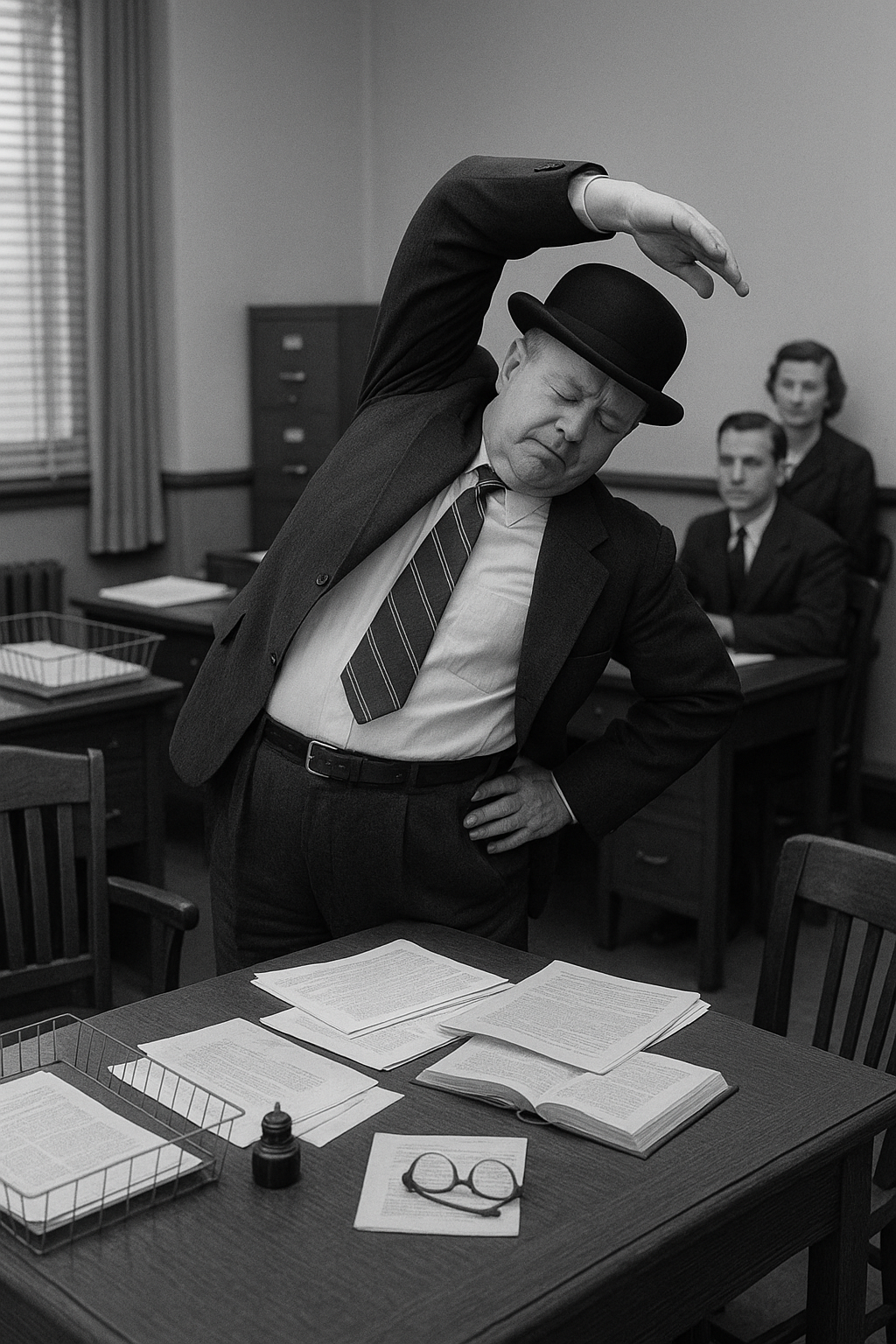 The first step toward recovery is to make peace with one’s desk. Treat it not as a prison, but as a platform for experiment. It can, when properly approached, serve as a bar for balance, a surface for stretching, and a witness to your redemption.
At least once every two hours (or every two pages of bureaucratic despair), stand up. The standing alone is half the cure. Let the spine recall that it is not ornamental. Extend the arms slowly overhead—not in triumph, but in forgiveness. Bend gently to one side and then the other, like a willow reconsidering the wind. The movement should not alarm nearby colleagues. If it does, you are doing it correctly.
Breathing for Beginners
Breathing, though commonly overlooked, remains an essential human function. Many desk workers engage in it only by accident. A good breath begins below the waistcoat; it should inflate the imagination as much as the lungs. Inhale through the nose as if smelling success, exhale through the mouth as if releasing regret. Repeat until serenity or faintness occurs—whichever arrives first.
A minute of deep breathing can achieve what half a dozen memoranda cannot: clarity, calm, and the faint conviction that one might survive until luncheon.
Exercises of Subtlety
For those unwilling to alarm superiors with visible calisthenics, subtler movements exist. Rotate the ankles beneath the desk as though stirring tea. Contract the stomach discreetly—five seconds of quiet resolve, repeated thrice. Roll the shoulders once for every complaint overheard in the office. These are the hidden labours of the industrious body, invisible but cumulative.
It is said that one senior clerk in the Ministry of Trade extended his career by fifteen years through a strict regimen of “invisible exercise.” Colleagues assumed him saintly; in truth, he was simply doing leg lifts during budget meetings.
The Perils of Posture
Poor posture is the true plague of our time. Men hunch like conspirators; women stoop as though apologising to their desks. Yet posture, more than any diet or tonic, determines vitality. To sit straight is to declare dominion over despair. To slump is to surrender to it.
Imagine a string attached to the crown of your head, tugging gently upward toward better habits. This simple image, if maintained, may save you the indignity of spinal ruin and the pity of your physician.
The Midday Constitutional
No office routine should exclude a brief walk outdoors, even if only around the block or to the nearest place where tea may be lawfully obtained. Sunlight, though sporadic in our climate, performs small miracles upon the nervous system. Fresh air, properly administered, clears not only the lungs but the conscience.
Upon returning to the desk, one should feel either invigorated or safely exhausted. Both conditions are preferable to the neutral misery of uninterrupted sitting.
The Ethics of Motion
Exercise, in the Eyehasseen tradition, is less about physique than propriety. It is indecent to treat the body as a mere transport for the head. A sound citizen must keep the limbs at least conversationally engaged with the rest of the person. As the noted philosopher of posture, Sir Randolph Cleever, once remarked:
“A slouching mind produces crooked sentences.”
By this logic, a nation of straight-backed clerks might yet save civilisation.
Conclusion: The Desk as Battlefield
Do not despise the desk—it is both adversary and ally. Upon its surface, empires of paper are conquered daily by men and women armed only with pens and patience. But between battles, one must stretch, breathe, and stand, lest the body surrender before the mind.
At day’s end, push back your chair, straighten your shoulders, and step into the corridor with the air of someone who has triumphed not over others but over inertia itself. You will find that the world looks different when viewed from a spine that remembers how to stand.
So rise, citizens of Eyehasseen—rise between paragraphs, between reports, between sighs. The Kingdom’s health may depend upon it.