By Cilla Hart, Arts & Letters Correspondent, The Times-Observer
On the eastern edge of Inverness, tucked between two crooked alleys and a canal that smells of old rope and rainwater, stands a building that glows even in daylight. Its wooden sign bears a painted lantern, worn to a smudge. Its shutters rattle in any wind stronger than a sigh. Its roof tiles resemble scales. And its stage—its impossible, shimmering stage—is lit not by gas lamps or electric bulbs, but by lanternlight reflected through a hundred tiny mirrors.
This is the Theatre of Lanterns, the oldest performing house in the Kingdom, and certainly the strangest. Some call it haunted. Some call it blessed. All agree it is unlike anything else in Eyehasseen.
A Stage Made of Light
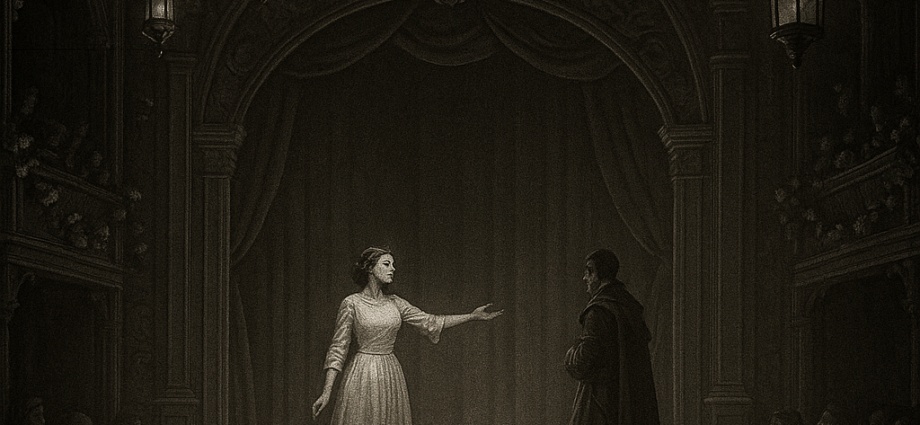
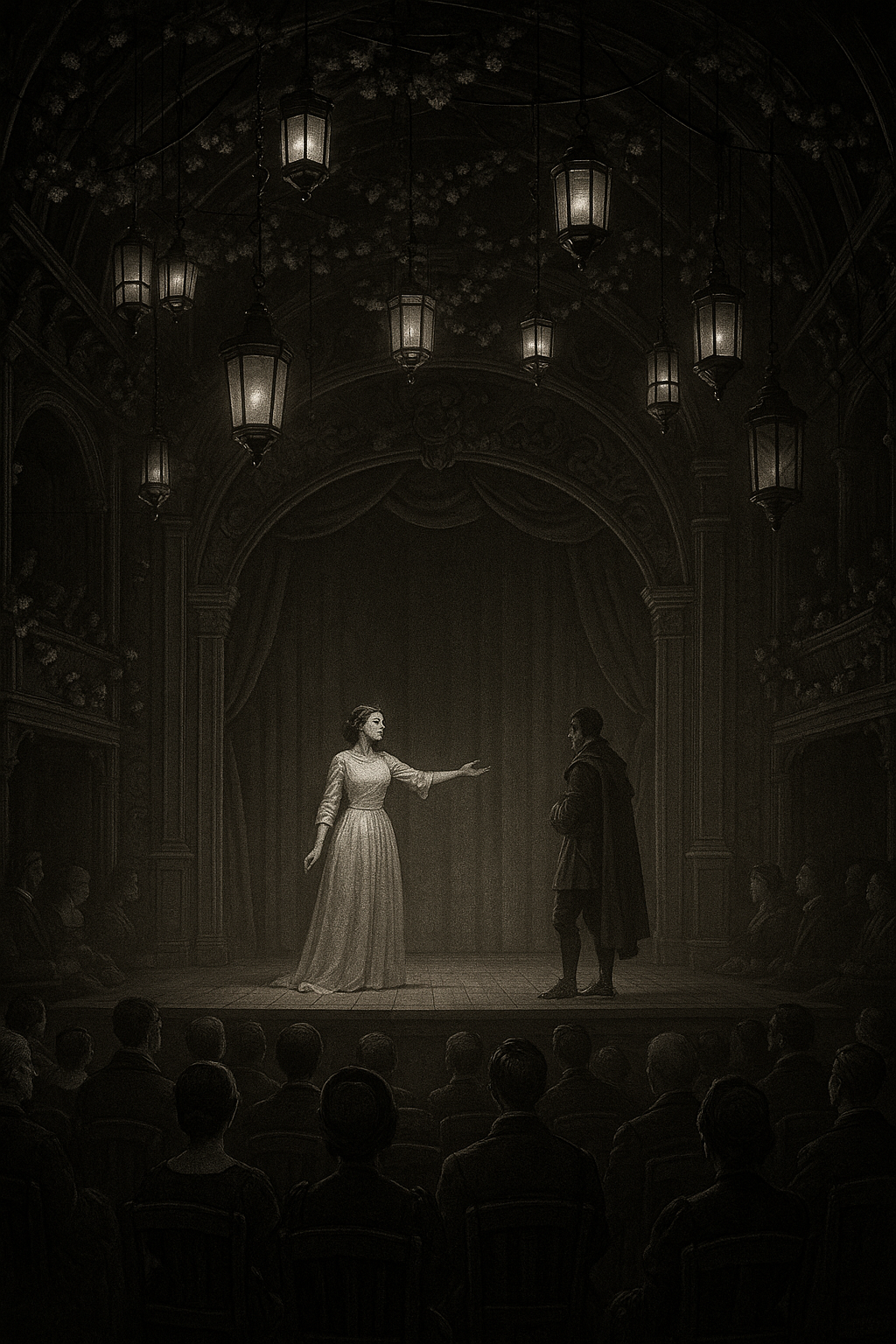 The theatre seats only two hundred, but when the performers step onto the creaking floorboards, the space transforms. The ceiling boasts a labyrinth of polished brass mirrors, pulleys, and panes of colored glass. Lanterns—real flame-burning lanterns—hang from tensioned wires and slide silently across the rafters. As they move, the mirrors catch their beams and scatter them into shapes that seem to breathe.
A wave of blue light washes over the stage like a rising tide. A shimmer of gold paints the air with dust motes that look like drifting stars. When the actors play ghosts, their shadows multiply into a swirling host behind them; when they stage storms, the lantern beams fracture into jagged bolts.
“It’s the oldest lighting system in the kingdom,” said Lorian Skiff, the current master of lanterns and keeper of the rafters. “And it works better than any of the new contraptions. Light has a soul. Electricity only has impatience.”
Skiff’s hands are scarred from decades of trimming wicks and polishing brass. During a performance, he moves along the narrow catwalks above the audience with the stealth of a spider, adjusting mirrors so precisely that a single lantern can paint the illusion of an entire sunrise.
Whispers Behind the Velvet Curtain
Actors here speak of the theatre as a living thing. They swear the stageboards creak warnings when someone misses their mark. They claim the mirrors whisper when left idle too long. And they insist that the theatre has moods—sad during summer, fierce during storms, gentle on nights when rain taps the windows softly.
When I asked whether these were superstitions, the lead actress Marianne Lothe gave a knowing smile.
“Every theatre is haunted,” she said. “But this one is polite about it.”
To illustrate, she led me backstage through narrow passages that smelled of varnish and rosewater. Costumes hung from pegs like sleeping ghosts. A single lantern flickered near a cracked plaster wall adorned with centuries of signatures from past performers. Some names had worn away entirely, as though swallowed by time.
“People have died here,” she added, still smiling. “But far more have lived. That’s what matters.”
The Prestidigitator of Light
The Theatre of Lanterns earned fame during the reign of Edmund II, when the illusionist Craven Vell used its unique lighting to stage his legendary trick, The Vanishing Court. With lanterns sweeping the floor in opposing arcs, mirrors splitting the beams into overlapping silhouettes, and actors moving in choreographed misdirection, Vell seemed to make the entire royal entourage disappear in front of a stunned audience.
The trick was so convincing that the King demanded a private demonstration. Vell declined. The next morning, he left town and was never seen again.
Lorian Skiff snorted when I asked if he knew the secret.
“He didn’t vanish the court,” Skiff said. “He vanished himself. Always the coward’s ending. But a beautiful trick, I’ll give him that.”
An Audience of Lanterns
The Theatre of Lanterns performs only at night. No matinees. “Lanterns don’t wake properly before dusk,” the ticket-taker told me with complete seriousness.
The show I attended, a tragedy called The Drowned Crown, unfolded with such visual splendor that even seasoned theatre-goers sat leaning forward as though the play might breathe on them. When the heroine walked across a projected bridge of reflected moonlight, several audience members gasped. When the villain’s shadow dissolved into a cascade of fractured beams, a child whispered, “Mama, he turned into stars.”
As the final lantern dimmed and darkness swallowed the stage, the audience sat silent for several long seconds, as if waiting to be sure the play had truly ended.
A Place That Remembers
Outside, the theatre’s crooked lantern sign swung faintly in the night wind. The canals reflected its glow in trembling shards. A man beside me murmured, “There is nothing else like it.”
He was right. The Theatre of Lanterns is more than a building. It is a memory you can walk into, a story told not in ink but in light. And when the last lantern is at last trimmed and the last mirror polished, the theatre will still hum with every performance it ever hosted.
Because some places do not forget.
And some lights never truly go out.