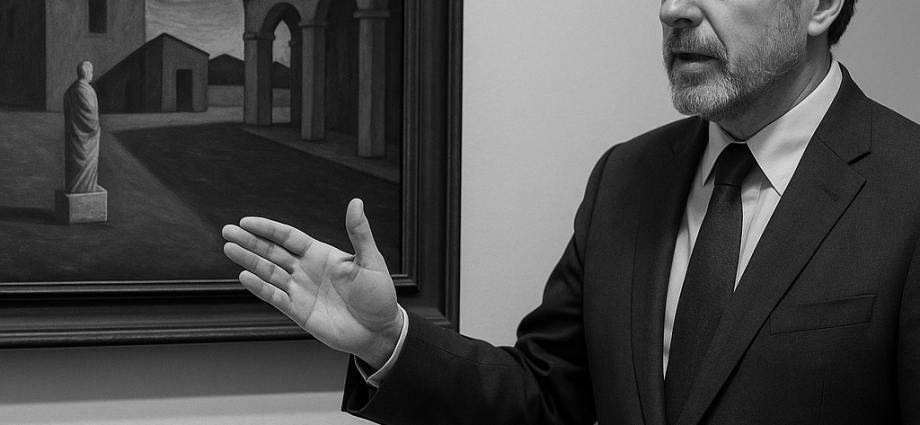
By Cassandra Blythe
Inverness — The Royal Museums of Eyehasseen has long prided itself on bringing the world’s cultural treasures to the people of Eyehasseen. Yet even among its storied exhibitions — the illuminated manuscripts of the Abbey of Marisport, the mosaics of Antioch, the bronzes of the Western Steppes — few have stirred the same anticipation as the new retrospective of René DeChirico, the Italian master of metaphysical painting.
 The exhibition, titled Shadows and Silence, gathers together for the first time in Eyehasseen a dozen of DeChirico’s most iconic canvases: deserted piazzas haunted by statues, long shadows cast by impossible suns, and lone figures adrift in dreamlike landscapes. It is a collection that whispers unease and mystery, and in doing so reflects the Kingdom’s own fascination with the borderlands of time, place, and perception.
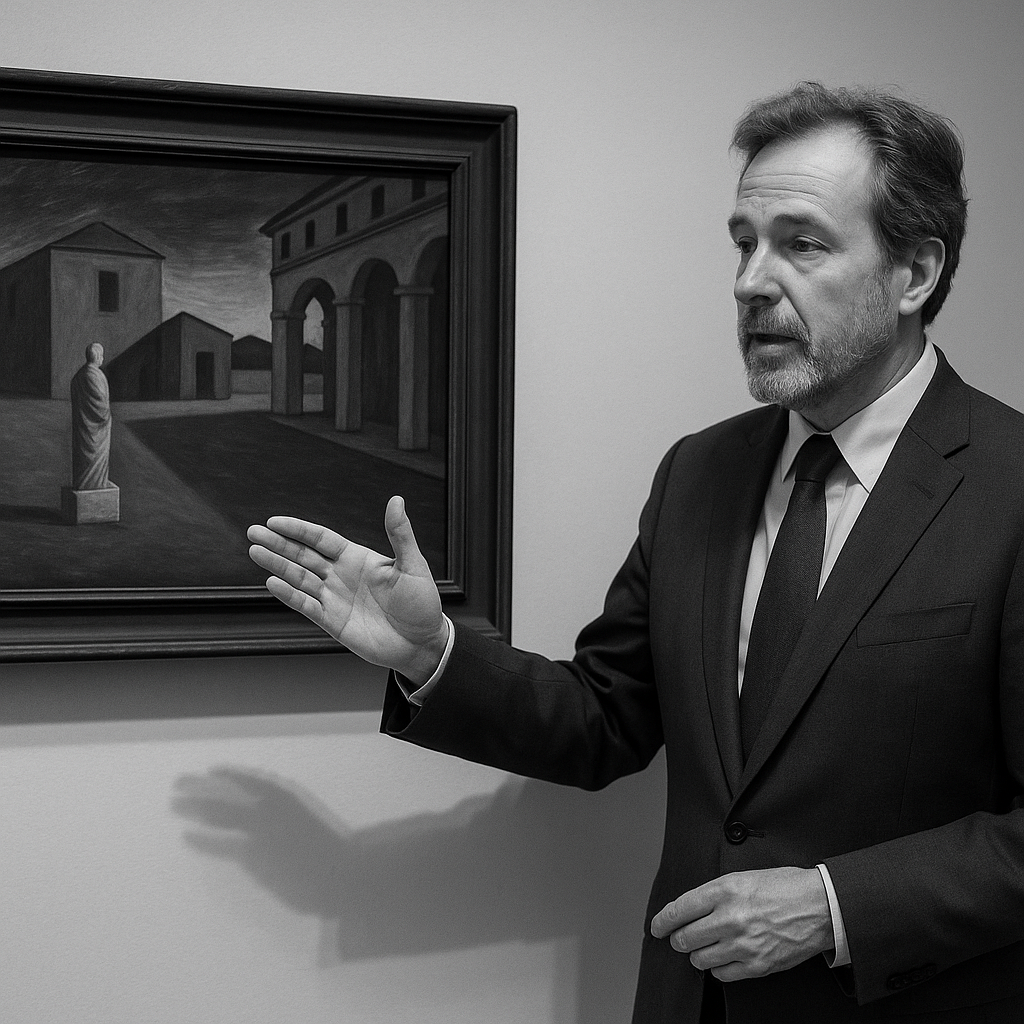
“This was not an easy exhibition to assemble,” admits Dr. Leontius Carr, the Museum’s chief curator, as he gestures toward a painting recently hung in the west gallery. “DeChirico’s works are scattered across private collections and museums in Paris, Rome, and New York. Convincing them to part with even one canvas for a season is a feat. To gather twelve? That required diplomacy, persistence, and no small measure of faith.”
Carr is not exaggerating. The negotiations stretched over three years, involving loans from the Musée d’Art Moderne in Paris, the Fondazione DeChirico in Rome, and a pair of private collectors in Switzerland whose paintings had not left their vaults in decades. One official compared the process to “assembling a clock from pieces kept in a dozen different houses.”
The effort was worth it. Visitors entering the exhibition are greeted by one of DeChirico’s most striking works, The Enigma of the Hour, in which a sunlit square is paradoxically filled with shadows, as though light itself had grown uncertain. From there, the journey proceeds through piazzas, arcades, and dreamscapes populated by silent statues and faceless mannequins. Each painting feels both eerily familiar and disquietingly strange.
“DeChirico teaches us to see absence as presence,” says Professor Amalia von Hart, an art historian who traveled from the University of Vienna for the opening. “His empty streets are not empty at all; they are charged with tension. The shadows, the arches, the stillness — they all speak of something just about to happen, or something that has just happened. That ambiguity is the genius of his work.”
The exhibition is also a milestone for the Royal Museum itself, founded in 1789 as a cabinet of curiosities for the royal household and gradually transformed into the nation’s premier cultural institution. Its mandate, Carr explains, has always been “to bring the world to Eyehasseen, and to place Eyehasseen in the world.” Hosting DeChirico here, he argues, is not merely about aesthetics but about reaffirming the Kingdom’s place within the global conversation of art and ideas.
Reaction has already been strong. On opening night, queues stretched from the colonnaded entrance down to the King’s Fountain. Some visitors spoke of being “enchanted” by the paintings’ dreamlike stillness; others admitted to being unsettled. “It’s as if time stopped and forgot to start again,” said one young visitor, staring at The Nostalgia of the Infinite.
Even those less versed in art history found themselves moved. “I don’t know much about painting,” confessed a railway engineer named Otto Klein, “but when I looked at that square with the statue, I felt like I’d been there before, in a dream I couldn’t quite remember.”
The exhibition will run for four months before the paintings return to their respective homes. For now, however, Eyehasseen is the custodian of a rare gathering of shadows and silence, a chance to walk among De Chirico’s enigmas without leaving the Kingdom’s borders.
Dr. Carr, pausing once more before the canvas, offers a final thought. “People think of museums as places where the past is preserved. But exhibitions like this remind us that art is also about the future. DeChirico asks us to imagine what is beyond the visible, beyond the ordinary. And that is a question as urgent today as it was a century ago.”