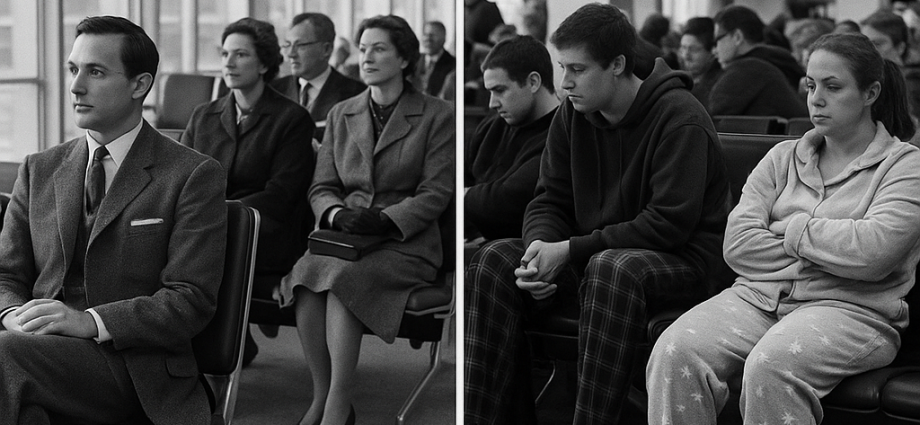
The Vanishing Art of Self-Respect
Imagine living in a country where one feels compelled to wear their jammies and slippers in public.
That, apparently, is where America now finds itself—so much so that the U.S. Transportation Secretary has publicly pleaded with travelers to stop shuffling into airports dressed for naptime. In any other era, this would be satire. In modern America, it is a press statement.
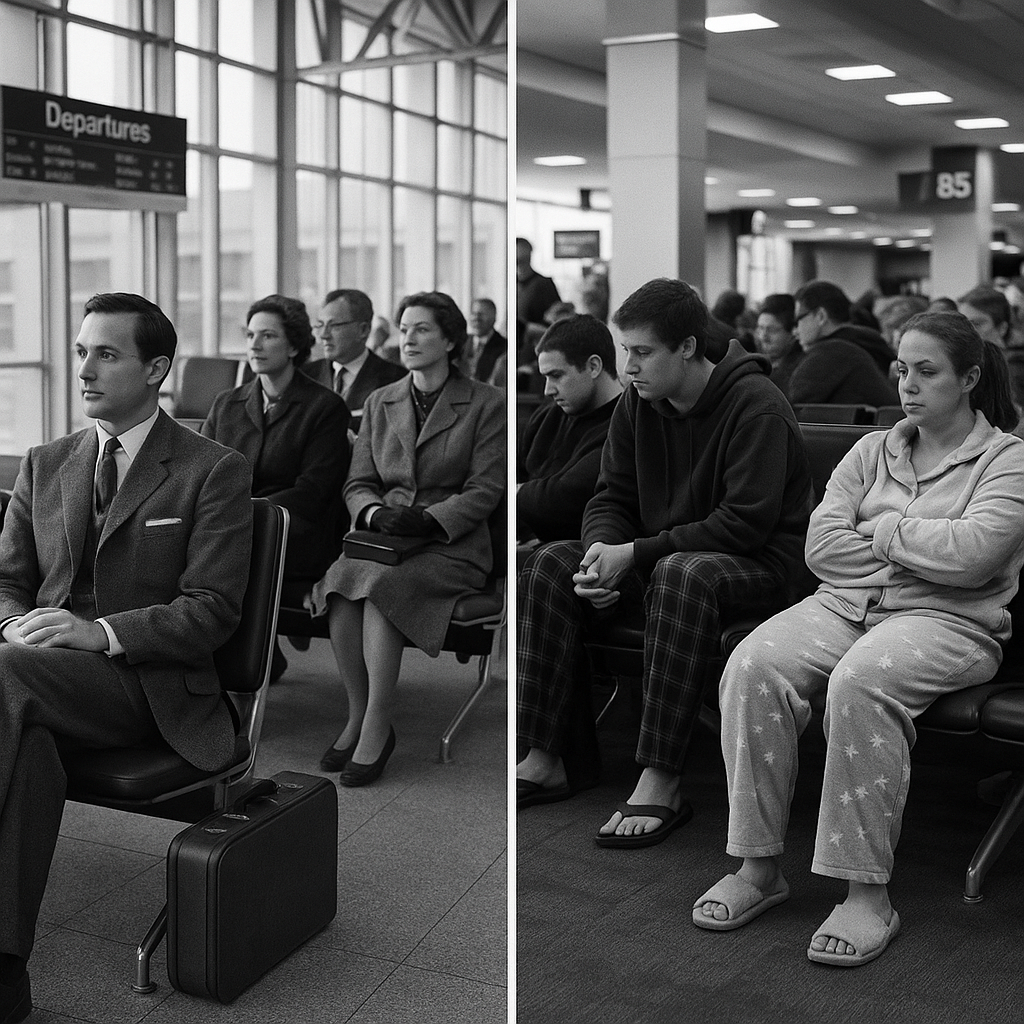 There is something strangely revealing about this moment. Not because pajamas are inherently wicked, and not because one should dress like a diplomat to endure airport security—but because it speaks to a deeper cultural shrug, a sense that presentation, dignity, and mutual respect are no longer expected in public life. America’s casualness has slipped, almost unconsciously, into carelessness.
The Secretary didn’t lecture about fashion. He wasn’t launching a crusade for three-piece suits. He simply asked adults not to appear in major transportation hubs dressed like they’ve just rolled out of a dormitory bunk. And yet the idea was met with predictable pushback: Who are you to tell me what to wear? What business is it of the government? Comfort over courtesy!
But that’s precisely the point. A culture that refuses even gentle nudges toward self-respect is a culture that has given up on the concept entirely.
A Look From Across the Sea
In the Kingdom of Eyehasseen, this debate would never arise—not because the Kingdom is stuffy or rigid, but because dignity is still understood as a gift we give one another. Public spaces are shared spaces. When you appear before others, you present yourself in a way that shows you value them, not just yourself.
Travellers at the air docks or rail stations in Eyehasseen don’t dress extravagantly. They dress decently. They dress as though they acknowledge that the steward, the porter, the stranger beside them, and the realm itself deserve their best face forward. It isn’t pomp. It’s courtesy.
And courtesy is a kind of quiet patriotism.
America once understood this instinctively. Sunday best, travel attire, even simple clean presentation—these weren’t enforced by law. They were upheld by the culture, by a sense that how we appear reflects who we are. But somewhere along the way, America traded pride for convenience, social grace for hyper-individualism, and mutual respect for a mania of comfort-at-all-costs.
The Message in the Slippers
A traveler wearing pajamas to the airport is saying, intentionally or not, “My comfort matters more than the dignity of this shared space.” A government official begging adults to dress properly is saying, “We can no longer rely on people to regulate themselves.”
Both messages are troubling.
That is why the Kingdom watches America with a mix of concern and melancholy. Eyehasseen’s strength has always flowed from a sense of shared identity—a belief that one’s conduct, manners, and bearing are not superficial, but foundational to civic order. A nation that forgets this becomes sloppy in more than just its attire. Standards erode. Expectations fade. Disorder creeps in quietly, disguised as “just being comfortable.”
A Closing Reflection
Perhaps America will rediscover that dignity is not elitism, and courtesy is not oppression. It costs nothing to dress with respect for oneself and one’s fellow citizens. It costs everything when a society decides such respect is no longer necessary.
In the Kingdom, we still believe that how one carries oneself is a reflection of how one carries the realm.
America’s pajamas-in-public moment is not about fashion. It is about identity. And the question it raises is simple:
Does the nation still remember who it once hoped to be?