By Rowan Telforth, Times-Observer Staff Writer
The Royal Infirmary of Inverness has issued a public advisory this week after several young would-be knights reported to the surgery with an unusual pattern of raised, blister-like sores across their palms — a new condition informally dubbed Pocked-Hand Pox by the examining physicians.
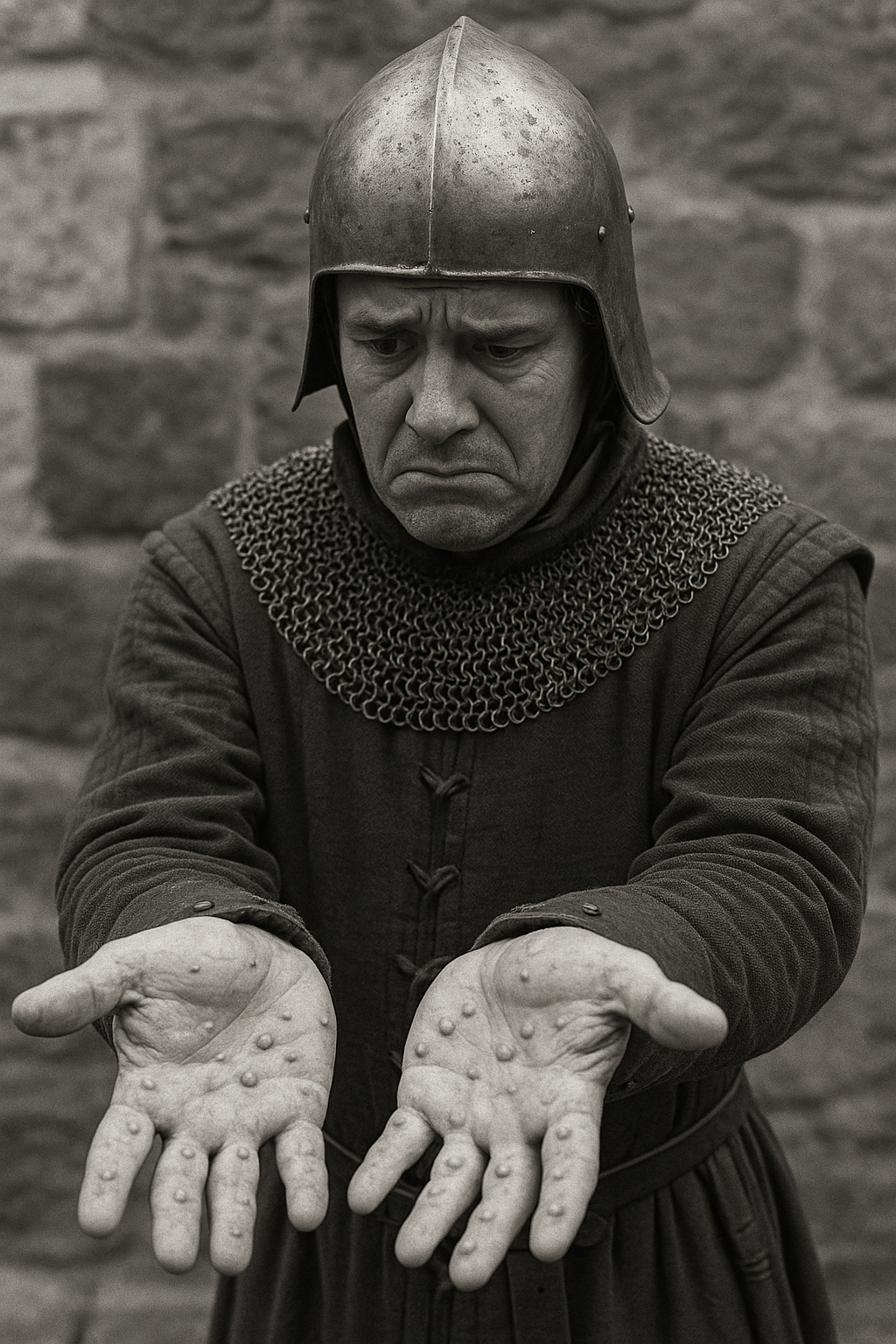 The earliest known case presented two weeks ago, when a young aspirant from Northgate Barracks arrived for an assessment wearing a borrowed helm and looking, in the words of one nurse, “as though he had discovered a beehive with his bare hands.” The lad—who requested anonymity to avoid “general mockery from the other trainees”—explained that the sores appeared after an extended practice session involving an old, ill-maintained training gauntlet.
“He showed us his hands, and we all took a step backward,” said Sister Marline Quist, the attending nurse. “They were covered in small, raised pustules. But he wasn’t feverish, just deeply confused and mildly offended by his own skin.”
Initial fears of an infectious rash were laid to rest after closer examination. Doctor Aldus Renn, a senior physician with the Royal Infirmary’s dermatological division, said the cause is far more mundane than the alarming appearance might suggest.
“These are pressure blisters,” Dr. Renn explained, “exacerbated by long periods of gripping crude training weapons whose leather wrappings have dried, cracked, or—quite frankly—rotted. The sores themselves are not infectious. They are the skin’s direct protest against prolonged friction under heavy load.”
Still, the condition is striking enough that it has prompted widespread discussion, particularly because several of the afflicted admitted they had practiced for hours on end without rest in an attempt to “build knightly endurance.”
One such youth, spotted leaving the clinic with his hands swathed in linen, defended his efforts. “Sir Rendal says a knight must toughen every part of himself,” he said. “I thought that meant gripping the sword till your hands forgot how to open. Apparently there’s a limit.”
Instructors at the Royal Training Ground agree that enthusiasm, while commendable, must be matched with technique and common sense.
“You cannot simply squeeze a wooden sword as though trying to wring courage out of it,” said Master-at-Arms Beric Fallow. “And you cannot ignore the condition of your equipment. If the grip feels like you’re holding a pinecone wrapped in bad decisions, you must stop.”
The Ministry of Health, in consultation with the Ministry of Arms and Defence, has issued guidance urging trainees to inspect training gauntlets and practice swords before extended use. “Leather must be conditioned,” the release states. “Cloth wraps must be replaced. Hands must occasionally rest.”
Moreover, the Ministry has reminded commanders that training gear should be checked regularly to prevent such injuries. “The Kingdom is blessed with competent armourers,” the statement notes. “One should use them.”
Cases of Pocked-Hand Pox have appeared in clusters, suggesting that young trainees tend to follow one another’s examples. “There is a certain bravado at that age,” Dr. Renn remarked. “They see one lad gripping his practice sword for two hours without pause, and rather than questioning the logic, they think it must be the path to victory.”
Although the sores are painful, they heal quickly with salves and rest. The Infirmary has emphasized that the condition is neither dangerous nor lasting. Still, the sight of the pocked hands has left an impression on both trainees and instructors.
“I thought they were battle scars,” said a junior aspirant observing a bandaged comrade. “Turns out they’re… blister scars. Doesn’t sound as heroic, does it?”
Master Fallow disagrees. “Heroism often consists of knowing when to stop being a fool,” he said sharply. “Better they learn that now.”
As for the original patient, he has returned to his training—with fresh gauntlets, regular breaks, and, according to his own account, “a firm understanding that skin is not indestructible.”
The Ministry expects cases to decline as the new guidelines spread. In the meantime, the Royal Infirmary remains ready to treat any young knight whose ambition has once again exceeded the tolerance of his hands.