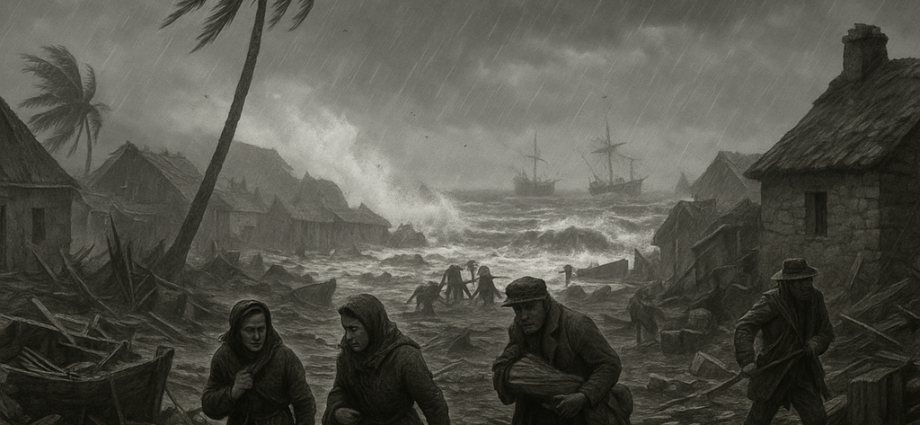
Times-Observer – International & Relief Affairs
For the second time in as many months, the remote Eastern Isles have been struck by a storm of such violence that even seasoned sailors of the Royal Navy describe it as “a sea-wall falling from the heavens.” The tempest, forming with unusual speed over the Warmwater Reach, carved a path directly across the isles of Longshore, Brinewake, and St. Melora’s Haven, leaving shattered homes, ruined fisheries, and thousands displaced.
From the mainland the destruction has been difficult to comprehend. Reports arriving in Inverness describe whole coastlines redrawn by storm surge, boats lifted into treetops, and centuries-old stone chapels standing as lone survivors amid fields of wreckage. The storms of the Eastern Isles have always held a grim reputation, but islanders say these last two rose with a ferocity unseen in living memory.
A Night of Ruin
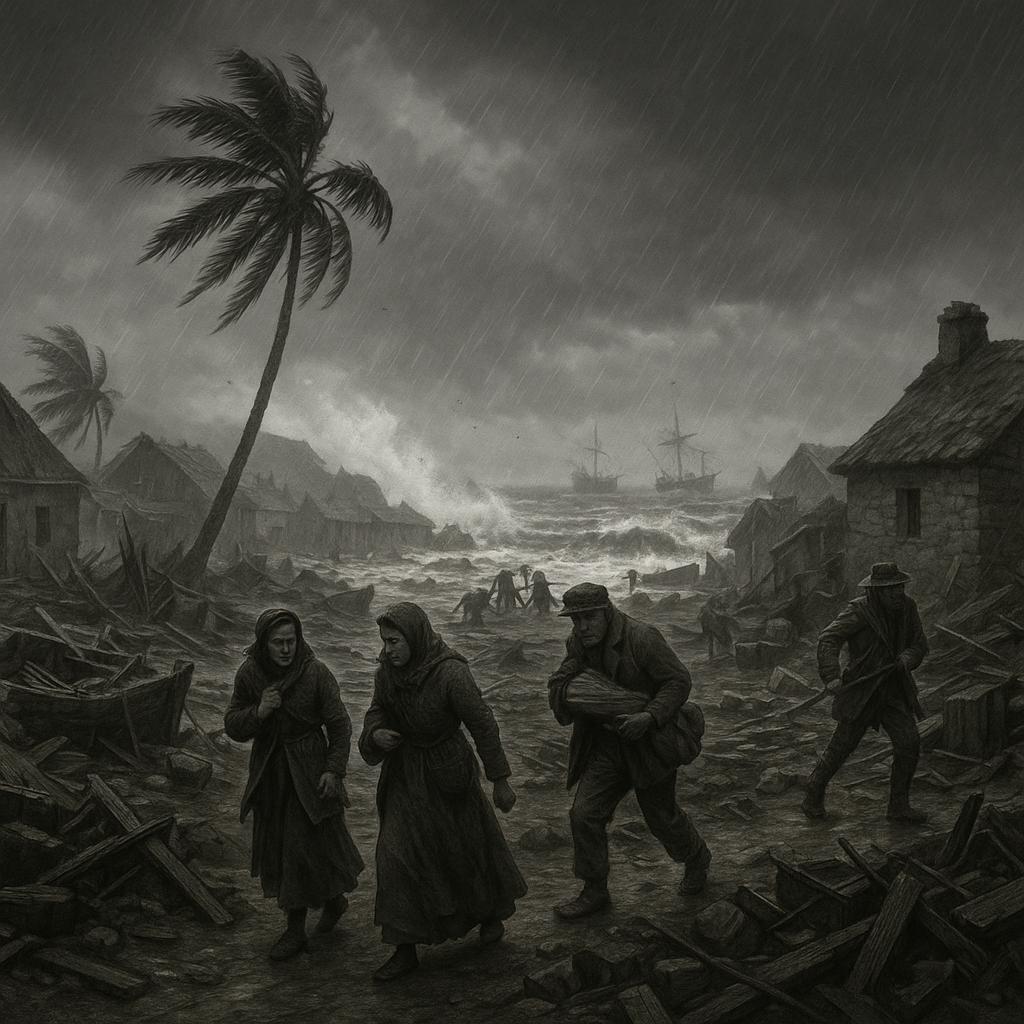 Witnesses in Longshore recount that the tempest arrived with barely an hour’s warning. Where the sea had been modestly rough at dusk, by nightfall it churned like a cauldron. The first waves struck with such force that the outer piers splintered instantly, sending fishing crates, nets, and lanterns into the black water. Wind tore through the palm scrubs and coastal grasses, hurling thatch from rooftops and scattering livestock. For the families who dwell closest to the shoreline, the only refuge lay in the hills and in the old stone churches built sturdily by the first settlers.
On Brinewake, the storm surge breached the seawall entirely, inundating half the island’s fertile plots. The loss of crops is expected to be profound; the Eastern Isles rely heavily upon their own harvests and shallow-water fishing for sustenance. As one local warden wrote in a dispatch, “It is as though the sea has claimed what the land promised.”
The Kingdom Responds
By first light, the devastation was already being counted. The Royal Navy’s Seventh Fleet, stationed at Dawnwatch, deployed three supply ships and an escort cutter toward the archipelago. Their arrival was met not with chaos but with remarkable order. Islanders, bruised and exhausted, had already begun clearing debris and organizing makeshift shelters, guided by instinctive cooperation that has long been the hallmark of life on the frontier edges of the Kingdom.
Captain Aldric Wynne of the cutter Resolute reported that “the people had already set themselves to the work. They had no time for despair. Every soul we met was carrying a beam, hauling rope, or tending a fire for the displaced.”
Alongside the Navy sail volunteer crews from various inland guilds: stone-masons, carpenters, brewers, and a contingent from the Port Inverness Merchant Cooperative carrying staples—grain, candles, and canvases for temporary roofing. Perhaps most moving is the presence of monks from the Abbey of St. Aidan, who have traveled to the isles on foot and by ferry, bringing blankets, medicines, and spiritual comfort.
A Lesson in Preparedness
Storms in the Eastern Isles are not new, but the speed of this tempest’s formation has drawn concern from the Royal Observatory. In a statement to provincial leaders, its scholars warned that changing wind patterns may make such “flash tempests” more frequent. They urge island councils to restore the old elevated storehouses—built generations ago for precisely these conditions—and to reinforce the stone piers using traditional deep-set footings, which have fared better than many modern constructions.
Island elders, interviewed at the Longshore shelter, echo this sentiment. One, Brenna Seagrave, remarked, “Our grandparents built the high granaries for a reason. We may have forgotten the lesson, but the sea has not.”
The Heart of the Isles
Despite the destruction, a remarkable spirit of unity permeates the relief efforts. Families who lost their homes are being taken in by those whose dwellings survived. Children assist in gathering driftwood; fishermen repair each other’s boats before their own. Even in hardship, the island way of life—marked by simple virtue, shared labor, and reverence for the sea—endures.
The Tempest of Longshore will undoubtedly be remembered as one of the worst natural disasters in recent island history. But as the Kingdom’s aid flows steadily across the sea, and as neighbors continue to help neighbors rebuild from the sand and ruin, the Eastern Isles show once again that resilience is not merely a matter of strength, but of steadfast charity.
A visitor to the site suggested it was “climate change”, to which a fisherman responded, “Eh, don’t confuse “climate” with “weather”, ya eedjit. Go back to New Yorkie where ya belong.”